

Three of the biggest names in American finance were hit by the same kind of attack in the same week — and none of them was hacked directly. On Thursday, November 19, 2026, JPMorgan Chase, Visa and Mastercard each confirmed that outside companies handling their customer data had been targeted in a cyberattack. The JPMorgan Chase data breach is the most closely watched of the three, because the leaked files appeared, according to a Reuters review, to contain the email addresses of more than 16,000 of the bank’s customers — including some of its wealthiest.
Here is the part that matters most: your money: in the reported leak, there is no evidence that funds were stolen, and no card numbers were exposed, and the banks say their own systems were never breached. What leaked was the kind of information that makes the next scam more convincing — names, email addresses and phone numbers. That is why this story matters even though there is no evidence that any account was emptied.
What happened: a vendor breach, not a bank breach
The JPMorgan Chase data breach did not start at JPMorgan. All three companies say the attackers got in through third-party service providers — outside firms that handle marketing and customer-engagement work for them. Your bank shares your contact details with companies like these every day, for cardholder benefit programs, marketing campaigns and customer service. Most customers never know those firms exist.
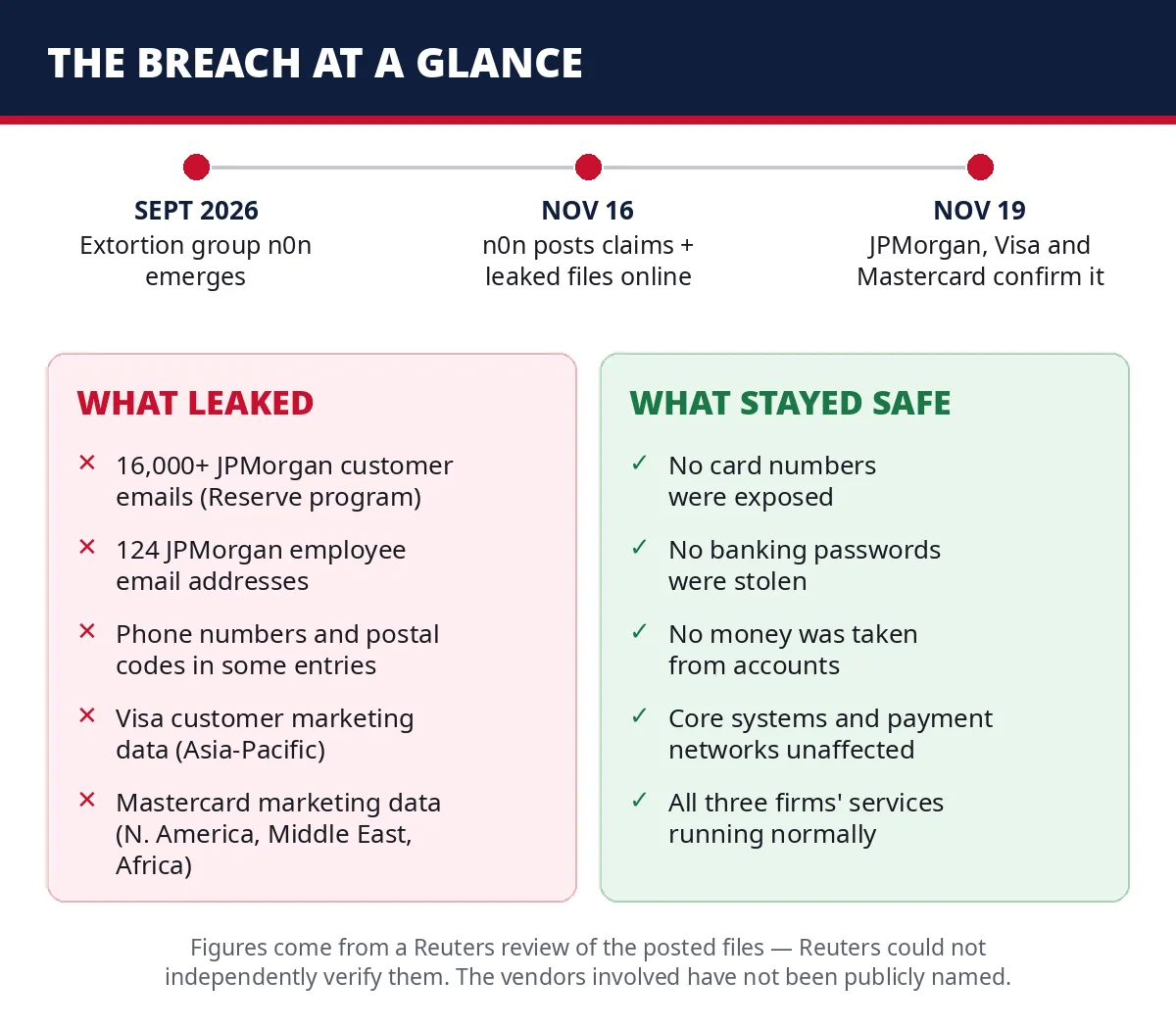
The timeline runs like this. In September 2026, a cyber extortion group calling itself n0n emerged; researchers say it has since claimed around 200 incidents. Although that count reflects claims made by the group itself and has not been independently confirmed. On November 11, the group claimed an intrusion at Qubole, a cloud data platform — a link that remains unconfirmed. On November 16, n0n posted claims and files online saying it had obtained cardholder marketing records linked to all three financial firms. On November 19, The Wall Street Journal reported that hackers had leaked customer data, and all three companies confirmed third-party incidents the same day.
What investigators have not yet established is whether a single compromised vendor sits behind all three exposures, or whether the firms were hit through different providers. None of the companies has publicly named the vendors involved — the biggest unanswered question in the story.
What was actually leaked
The fullest picture of the JPMorgan Chase data breach comes from a Reuters review of the files the group posted online. Reuters reported that the material appeared to contain more than 16,000 JPMorgan Chase customer email addresses and 124 bank employee email addresses, with some entries also including phone numbers and postal codes. Reuters stressed that it could not independently verify the authenticity of the data, and JPMorgan declined to comment on the leaked files themselves.
What made the JPMorgan files stand out is who they appear to belong to. The records seem to be linked to the bank’s Reserve program — its invitation-only premium Visa card, which Newsweek reported generally requires customers to have at least $10 million in assets under management. The exposure appears to touch some of the bank’s richest clients, not just everyday account holders.
The picture at the other two firms is different in scale and geography. The purported Visa data largely concerns Asia-Pacific markets, including Hong Kong, Japan, Singapore, Australia and South Korea, and appears to consist of customer email addresses, phone numbers and marketing campaign data. The Mastercard material includes marketing data for customers in North America, the Middle East and Africa, plus a small number of employee email addresses. Mastercard said only a small subset of cardholders in one benefit program was affected, and it has not named the program or given an exact number.
What was not touched
The reassuring half of the story is unusually clear, because all three companies said the same thing in different words: the important stuff stayed safe. JPMorgan said its services were not disrupted, and that there was no connection to the transaction problems some customers saw earlier in the week, which the bank blamed on a software bug. Visa said its systems “were not involved and were not impacted” and that no payments data such as card numbers was affected. Mastercard said there was no impact to its payment network, and that the exposure had been contained.
“Based on our investigation so far, we believe the attackers accessed certain marketing data held by those vendors, which may include some customer names and email addresses.” — JPMorgan Chase
There is also no verified indication that customer banking passwords were stolen or that hackers accessed anyone’s funds. A leak of contact details is a serious privacy problem, but it is not the same as a bank robbery. The danger it creates is indirect — it hands scammers the raw material for far more convincing fraud attempts.
Who is n0n?
The group behind the claims calls itself n0n, and it has become one of the fastest-moving extortion outfits of the year. Cyber threat researchers at SocRadar, who documented the group in September, described it as an AI-powered extortion operation that had infiltrated at least 93 organizations across 18 countries, with total ransom demands of $283.7 million. The cybercrime research platform eCrime.ch puts its claimed incident count at roughly 200 since it emerged. That count is based on claims by the group itself, and SOCRadar notes it has not independently confirmed that n0n carried out these attacks.
That is what is striking about n0n’s reported method is how unglamorous it is. According to researchers, its attacks have relied on weak or stolen credentials rather than sophisticated software vulnerabilities — on passwords and logins that were already compromised, used against systems that trusted them. The front door of a bank can be excellent while a vendor’s side door is left open.
Why this breach is a warning for everyone
The JPMorgan Chase data breach is a reminder of something most customers never think about: your bank is only one of many companies holding your personal information. Marketing firms, benefit-program administrators and data platforms all hold pieces of it, and their security is not the bank’s security. You can do everything right with your own account and still be exposed because a company you never heard of was breached.
It has been a rough week for American technology, with a Microsoft outage and transaction glitches at several banks — and just days earlier, a major Apple outage knocked out iCloud and the App Store. Not every alarming outage is an attack: earlier in the week, officials said the NSA outage was maintenance, not a cyberattack. But the JPMorgan Chase data breach was a real attack, on real customer data, through a door the victims did not control.
The timing makes it worse. The breach news landed days before Black Friday, the busiest shopping week of the year, when inboxes are already full of order confirmations and discount offers. Scammers love that noise, because a fake “your account was affected by the breach” email blends in perfectly — and this year they can address it to the right person, by name. If you are hunting deals, our Black Friday 2026 deals guide covers when the genuine sales actually start.
What to do if you are a customer
Watch for these warning signs: a message that uses your name and email address, says your account was affected, pressures you to act urgently, or asks you to click a link, read back a code, or move money to a safe account.
You do not need to assume your account has been compromised. But a few practical steps are worth taking this week, whether or not your details were in the leaked files. Treat any unexpected email or text about the breach as suspicious until proven otherwise: do not click links or open attachments in messages claiming your account needs attention. Instead, open your bank’s official app or type its web address into your browser yourself, or call the number printed on the back of your card. A scammer may already know your name and email address and use them to sound legitimate — and may ask you to read back a one-time verification code. Never share a verification code with someone who contacts you unexpectedly, and never move money to a supposedly “safe account” because a caller tells you to. A real bank will never ask you to do either.
Turn on transaction notifications in your bank or credit card app, so unfamiliar purchases surface immediately. Use unique passwords for your banking and primary email accounts, and switch on multi-factor authentication — an authenticator app is stronger than SMS codes, and passkeys are stronger still. If JPMorgan contacts you, check that the message genuinely came from the bank before clicking any enrollment link: the bank says it will contact affected customers where appropriate and offer support, including complimentary credit monitoring. A credit freeze — free through Equifax, Experian and TransUnion — makes it harder for criminals to open new accounts in your name, and it does not affect your credit score. And if you do fall for a scam, report it at ReportFraud.ftc.gov.
What we still do not know
Several important facts are still missing. The vendors have not been named. It is not confirmed whether one provider served all three firms or each was hit separately. The exact number of affected Visa and Mastercard customers has not been disclosed. The authenticity of the posted files has not been independently verified. And the claimed link to the Qubole platform is unconfirmed.
Until those answers arrive, the honest summary is this: the JPMorgan Chase data breach exposed the contact details of thousands of customers — including some very wealthy ones — through companies most of them had never heard of, while, in the reported leak, there is no evidence that money, cards or passwords were taken. The companies say the exposure has been contained. The phishing wave it enables is just beginning — and that is the part customers can actually defend against.
Frequently Asked Questions
Was my money at risk in the JPMorgan Chase data breach?
No verified evidence suggests funds were accessed. JPMorgan, Visa and Mastercard all say their core systems and payment networks were unaffected, services kept running, and no money was taken. What leaked was contact and marketing data — names, email addresses and, in some entries, phone numbers — which is mainly useful to scammers for phishing, not for moving money directly.
What information was leaked in the JPMorgan Chase data breach?
According to a Reuters review of the posted files, the material appeared to contain more than 16,000 JPMorgan customer email addresses and 124 employee email addresses, some with phone numbers and postal codes. The records appear linked to the bank’s premium Reserve program. Visa and Mastercard exposures involved customer marketing data in Asia-Pacific and in North America, the Middle East and Africa. Reuters could not independently verify the files.
Were card numbers or passwords exposed?
No. All three companies say no payment data was exposed: Visa states no card numbers were affected, Mastercard says only non-payment information from a small subset of cardholders leaked, and JPMorgan says the accessed data was marketing data held by vendors. There is also no verified indication that banking passwords were stolen.
What should I do if I get an email about the breach?
Do not click links or attachments in the message. Open your bank’s official app or type its web address into your browser, or call the number on the back of your card. Never share a one-time verification code with an unexpected caller, and never move money to a “safe account” on anyone’s instruction. If JPMorgan offers you complimentary credit monitoring, verify the message came from the bank before enrolling.
Sources
- Fox News
- Channel News Asia
- TechSpot
- SOFX
- The Statesman
- Reuters – JPMorgan says third-party vendors targeted in cyberattack
- Wall Street Journal – Visa, Mastercard and JPMorgan Customer Data Leaked by Hackers
- JPMorgan Chase – Statement on X (Chase)
- Visa – Statement to Cybersecurity Dive
- Mastercard – Statement to Cybersecurity Dive
- SOCRadar – Ransomware Threat Actor Profile: n0n