


Try the Pet Pregnancy Calculator — it’s free
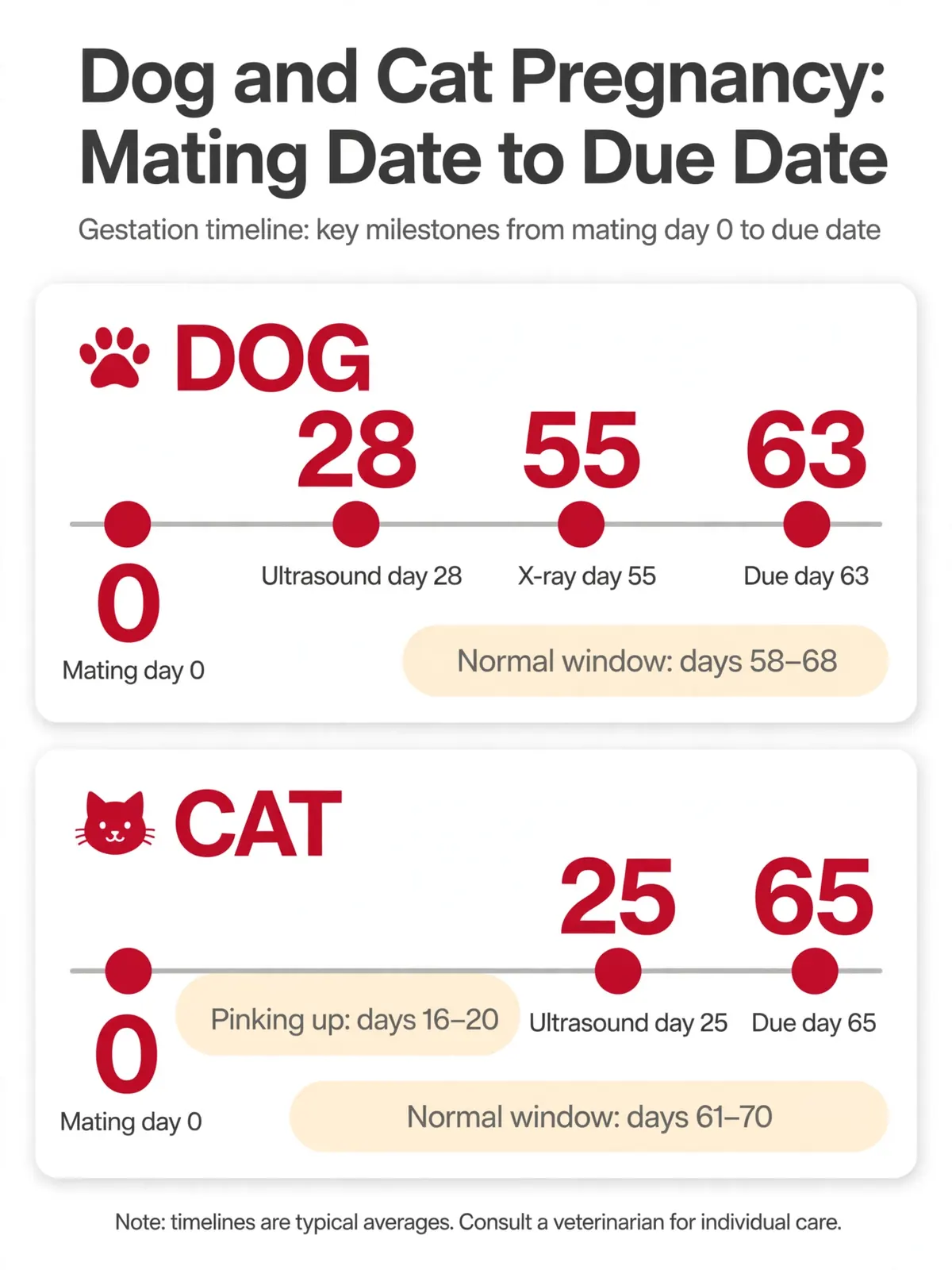
A dog is pregnant for about 63 days. A cat is pregnant for about 63 to 65 days. A pet pregnancy calculator takes the one date most owners actually know — the day she mated — and adds those days to it, giving you an estimated due date and the normal window around it.
Why it matters: nine weeks passes fast. The due date a pet pregnancy calculator gives you decides when to book the ultrasound, when to change her food, when to set up the whelping box, and when to stay home. A date on the calendar turns a guess into a plan.
By the numbers
The numbers a pet pregnancy calculator runs on:
- 63 days — the average dog pregnancy, counted from ovulation, according to the American Kennel Club and the Merck Veterinary Manual.
- 58 to 68 days — the normal whelping window for dogs counted from the first mating, per the Merck Veterinary Manual.
- 63 to 65 days — the average cat pregnancy, according to the Cornell Feline Health Center and PetMD.
- 61 to 70 days — the window in which 95 to 97 percent of queens give birth, according to a 2022 review in the Journal of Feline Medicine and Surgery.
- 6 hours — the time most cats deliver their whole litter in, according to PetMD.
How a pet pregnancy calculator works
The maths is simple. The hard part is knowing which starting date to count from. A pet pregnancy calculator asks for the mating date and the species, then adds the average gestation length. The result is a centre point, not a promise — so a good calculator shows the whole normal window beside it. That is the whole job of a pet pregnancy calculator: one date in, one window out.
| Pet | Count from | Add | Normal window |
|---|---|---|---|
| Dog | First mating | 63 days | Day 58 to day 68 |
| Dog | Ovulation (vet-timed) | 63 days | Day 62 to day 64 |
| Dog | LH surge (vet-timed) | 65 days | Day 64 to day 66 |
| Cat | First mating | 65 days | Day 61 to day 70 |
Enter the most accurate date you have. If your vet timed ovulation with progesterone tests, use that date — the window shrinks to about two days. If all you have is the mating date, use that and plan for the full window. If she mated on several days, enter the first mating for the earliest date and the last for the latest.
Worked examples: real dates, real due dates
Here is what a pet pregnancy calculator gives you for two matings in November 2026. Check the maths yourself — add 63 days for a dog, 65 for a cat.
| Mated on | Pet | Estimated due date | Normal window — be ready from |
|---|---|---|---|
| 1 November 2026 | Dog | Sunday, 3 January 2027 | Tuesday, 29 December 2026 to Friday, 8 January 2027 |
| 1 November 2026 | Cat | Tuesday, 5 January 2027 | Friday, 1 January to Sunday, 10 January 2027 |
| 15 November 2026 | Dog | Sunday, 17 January 2027 | Tuesday, 12 January to Saturday, 23 January 2027 |
| 15 November 2026 | Cat | Tuesday, 19 January 2027 | Friday, 15 January to Sunday, 24 January 2027 |
Two things jump out. First, the same mating date gives a different due date for a dog and a cat — two days apart on the averages, and the windows barely overlap. Second, the window is wide: ten days for a dog, nine for a cat. That is the honest answer. A pet pregnancy calculator does this maths in seconds — the table above is the same result, written out so you can check it.
Why the mating date is not the whole story
A mating date and a conception date are not the same thing, and the gap is the reason due dates wobble. In dogs, sperm can survive in the female for several days, and her eggs need two to three days after ovulation to mature before they can be fertilised, according to Cornell. So a bitch mated on Monday may not actually conceive until Thursday. Counted from the first breeding, the Merck Veterinary Manual puts the normal range at 58 to 72 days — a full two weeks. That gap is exactly what a pet pregnancy calculator cannot see: it knows the mating date, not the ovulation date.
Cats work differently. A queen is an induced ovulator: mating itself triggers ovulation, so the mating date is a better starting point than it is for dogs. But a queen can mate with more than one tom in the same heat, and kittens in one litter can have different fathers — superfecundation. It barely changes the due date, but it is one more reason the date is a window, not a deadline.
The fix, if you need a tight date, is a vet-timed one: progesterone tests pin ovulation to within a day or two, and from ovulation a dog’s due date is 63 days, give or take one to two. Most pet owners do fine with the mating-date estimate — as long as they plan for the whole window.
Does breed or size change the due date?
A little, and mostly for dogs. The 63-day average holds across breeds, but small and giant breeds sit a day or two either side of it. A pet pregnancy calculator uses the 63- and 65-day averages, so breed shifts the answer by a day or two at most — worth knowing, not worth re-doing the maths over.
| Pet | Type | Average gestation | Normal window from mating |
|---|---|---|---|
| Dog | Small or toy breeds | About 62 days | Day 57 to day 67 |
| Dog | Medium breeds | About 63 days | Day 58 to day 68 |
| Dog | Large or giant breeds | About 64 days | Day 59 to day 69 |
| Cat | Siamese | About 63 days | Day 61 to day 70 |
| Cat | Persian | About 65 days | Day 61 to day 70 |
| Cat | Most other breeds | 63 to 65 days | Day 61 to day 70 |
Litter size pulls the other way. Larger litters tend to arrive a little earlier in cats, according to a review of breeder records in Theriogenology, which put the average cat gestation at 65.6 days, with Siamese queens averaging 63 days and Persians 65. If your queen is carrying a big litter, have the nesting box ready a few days early.
Week by week: what happens, and what to do
Both pregnancies run about nine weeks, in three rough trimesters of about three weeks each. A pet pregnancy calculator turns those nine weeks into dated milestones — here they are, side by side.
| Week | Dog — what happens | Cat — what happens | What you do |
|---|---|---|---|
| 1–2 | Eggs fertilise and travel to the uterus. Nothing shows. | Mating triggers ovulation. Nothing shows. | Keep food and walks normal. Note every mating date. |
| 3 | Embryos implant around day 18–21. Some dogs go off food briefly. | Nipples “pink up” around days 16–20. | Book the vet check. Keep her indoors — a cat can mate again. |
| 4 | Fetuses take shape; eyelids by day 32, toes by day 35. | Belly starts to round. A vet can feel kittens from about two and a half weeks. | Ultrasound from about day 25–28 confirms the pregnancy. |
| 5–6 | Belly rounds out, appetite rises. Puppies look like puppies. | Weight gain, bigger belly, more sleep, clingier mood. | Ask the vet about food — see the note below. |
| 7 | Skeletons show on X-ray from about day 42–45. Movement felt after day 50. | Belly clearly large. Kittens may be felt moving. | Set up the birth box. X-ray counts the litter after day 55 (dogs). |
| 8 | Mammary glands develop. She may eat up to 1.5 times normal. | Nipples swell, belly grooming increases. Appetite stays high. | Smaller, more frequent meals. Keep the birth area quiet. |
| 9 | Nesting, restlessness, temperature drop. Whelping usually lands here. | Restlessness, nesting, loss of appetite. Most cats deliver within about 6 hours. | Stay close. Have the vet’s emergency number to hand. |
The signs are clues, not proof. A false pregnancy can copy every one of them in a dog — bigger nipples, a rounder belly, even nesting — so a vet check is the only way to be sure she is actually pregnant.
Vet checks, food and getting the birth area ready
A pet pregnancy calculator gives you dates. The vet gives you certainty. Book the first check at around day 25 to 30: an ultrasound from about day 28 is usually reliable in dogs, and in cats heartbeats can be seen by ultrasound at three to four weeks, according to PetMD. A relaxin blood test works from about day 22 to 27 in dogs. An X-ray after day 55 is the best way to count puppies, because it tells you on the day whether she has finished. None of that comes from a pet pregnancy calculator — the calculator sets the dates, the vet confirms what is happening on them.

Food changes late, not early. VCA Animal Hospitals advises that a pregnant dog’s food intake stays roughly the same for the first two-thirds of pregnancy, then rises to about one and a half times normal in the last three weeks, in smaller, more frequent meals of a food labelled for gestation and lactation. PetMD gives the same advice for cats. Do not add calcium or other supplements unless your vet tells you to — extra calcium in pregnancy can do harm, not good. A pet pregnancy calculator cannot tell you what to feed her — that is the vet’s job.
Set up the birth area a week or two before the earliest date in the window, not the due date itself. A whelping box for a dog, a lined cardboard box or covered bed for a cat, in a quiet, warm, draft-free spot she can get used to. For a dog, take her temperature twice a day in the final week. Her normal temperature sits near 101.5°F; when it drops below 99°F, labour is usually less than 24 hours away. That single number is the best warning you get.
When to call the vet
Some signs mean call now. Others mean book a visit this week.
Call the vet now — do not wait: she strains hard for 30 to 60 minutes without producing a puppy or kitten; more than two hours pass between puppies; you see dark green or black discharge before the first puppy is born; she is restless, stiff, trembling or has a seizure after giving birth; or the due window has passed with no labour at all. VCA Animal Hospitals lists all of these as reasons to contact a vet during whelping. Keep the pet pregnancy calculator’s window in mind here: “overdue” means past the window, not past the single due date.
Book a vet visit this week: vomiting that keeps going or weight loss in early pregnancy; she refuses food for more than a day before the final week; a smelly discharge at any point; or a cat past day 70 with no sign of labour. A small amount of reddish discharge near the vulva late on is normal in cats and means labour is close — but heavy bleeding is not, and that is a call-now sign.
What if you do not know the mating date?
It happens a lot, especially with cats — many cat pregnancies are unplanned, and the owner only notices the signs at week three or later. A pet pregnancy calculator needs a date, so without one you work backwards from what you can see. That is the one case where a pet pregnancy calculator cannot help, and the vet visit replaces it.
Use the signs as a rough clock. In cats, pinking up points to around day 16 to 20, a round belly to day 30 onward, nesting and a dropped appetite to the final days. In dogs, a vet can feel the pregnancy from about day 28, and an ultrasound can measure the puppies and date it from their size — far better than a guess from belly size.
What this means for you
A pet pregnancy calculator is a planning tool, and a good one, as long as you read it the way it is meant to be read: a centre date with a window around it, not a day circled in pen. Dogs average 63 days from ovulation and cats 63 to 65, the mating date is only a proxy for the real start, and the vet’s ultrasound and X-ray are what turn the estimate into a plan you can trust.
Run the numbers through a pet pregnancy calculator the day you know she mated. Book the vet at day 25 to 30. Have the birth area ready by the first day of the window. And keep the emergency number where you can reach it in the dark — the nine weeks go by faster than you think. You can find the calculator and more guides on the Current Affiars homepage.
Frequently Asked Questions
How accurate is a pet pregnancy calculator?
A pet pregnancy calculator gives an estimate and a likely window, not an exact day. From a mating date, most dogs whelp between day 58 and day 68 and most cats give birth between day 61 and day 70. A vet-timed ovulation date narrows a dog’s window to about two days.
Can I use the same pet pregnancy calculator for a dog and a cat?
Yes, if it asks for the species — the two need different numbers. Dogs average 63 days from ovulation, cats 63 to 65 days from mating, and the windows differ too. A pet pregnancy calculator that uses one figure for both will be wrong for one of them.
My dog mated on several days. Which date do I enter?
Enter the first mating date for the earliest possible due date and the last mating date for the latest, and plan for the whole span between them. Sperm can survive for days, so no single date in the middle beats the window. If your vet timed ovulation with progesterone tests, use that date instead.
When can a vet confirm my pet is pregnant?
An ultrasound can confirm a dog’s pregnancy from about day 25, and is usually reliable after day 28. In cats, heartbeats show at three to four weeks. A relaxin blood test works in dogs from about day 22 to 27. An X-ray after day 55 counts the litter, but cannot confirm a pregnancy early on.
What should I do if the due date passes with no labour?
First check the pet pregnancy calculator’s window, not the single date — a dog is still normal up to day 68 from mating, and a cat up to day 70. If the whole window has passed, call your vet the same day. A pregnancy running past day 70 in a cat or day 72 in a dog needs a vet’s assessment.
Related Reading
- Pet Pregnancy Calculator — work out your dog or cat’s due date
- Dog Age Calculator: How Old Is Your Dog in Human Years?
- Cat Age Calculator: How Old Is Your Cat in Human Years?
- Dog Feeding Calculator: How Much Food Does Your Dog Really Need?
- More in Pet Care