


Try the Dog Feeding Calculator — it’s free
How much food should your dog eat? The short answer: a 10 kg neutered adult dog needs about 630 calories a day — roughly 1¾ cups of a typical kibble. But that number is only right for that dog. A puppy the same weight needs more than double. A senior on the sofa needs less. This guide explains how a dog feeding calculator works: the veterinary formula, a feeding chart by weight, worked examples, and the mistakes that make most owners overfeed without knowing it.
Why it matters: according to the Association for Pet Obesity Prevention, 59% of dogs in the United States are overweight or obese — 37% overweight and 22% obese — and most of their owners do not realise it. Dogs kept lean live longer: in a landmark 14-year study, dogs kept at an ideal weight lived a median of 1.8 years longer than their overweight littermates. The bowl is where that starts, and a dog feeding calculator is the fastest way to get the number right.
Why the bag chart overfeeds most dogs
The feeding guide on a bag of dog food is an average worked out for a wide range of dogs — usually intact, active animals — and it is famously generous. Bags are written to cover the biggest, most active dog in each weight band, so a calm, neutered house dog fed “by the bag” often gets 20–30% more than it needs — the small daily surplus behind most quiet weight gain.
The bag has a second problem. It tells you cups, but a cup is not a fixed amount of food: kibble ranges from about 300 to 450 calories per cup, so the same “2 cups” can mean 600 calories or 900. PetMD’s guide shows it with a real food — a Purina Pro Plan recipe at 382 calories per cup feeds a 21–35 lb dog 1⅔–2⅓ cups a day. Change the food and the cups change too — which is why a dog feeding calculator asks for your food’s calories per cup.
A dog feeding calculator fixes the first half of the problem: it starts from your dog’s actual calorie need, using the same resting-energy formula vets use, instead of a one-size-fits-all chart. The second half — checking whether the number is right for your dog — is the body condition check further down this page.
The science: resting energy, then real life
Vets do not start from cups. A dog feeding calculator starts from calories, in two steps. The first number is the resting energy requirement (RER) — the energy a dog burns at rest — from a formula published by the National Research Council and used in the American Animal Hospital Association’s 2021 Nutrition and Weight Management Guidelines:
RER (kcal/day) = 70 × (body weight in kg)0.75
The 0.75 exponent is the interesting part: smaller animals burn more energy per pound, so calories do not rise in a straight line with weight — a 10 kg dog needs about 1.7 times the food of a 5 kg dog, not twice as much. (A shortcut — 30 × weight in kg + 70 — only holds for dogs between about 2 and 45 kg, so a dog feeding calculator should use the full formula, which is what ours does.)
The second step turns resting energy into the daily target. RER is the floor, not the answer: a real dog walks, plays, grows or ages, so vets multiply RER by a life-stage factor to get the maintenance energy requirement (MER) — the factors below, from the AAHA 2021 guidelines:
| Life stage / activity | Multiply RER by |
|---|---|
| Weight loss (at ideal weight) | 1.0 |
| Inactive / prone to weight gain | 1.0–1.2 |
| Neutered adult | 1.4–1.6 |
| Intact adult | 1.6–1.8 |
| Senior, less active | 1.4 |
| Light work | 1.6–2.0 |
| Puppy, under 4 months | 3.0 |
| Puppy, 4–12 months | 2.0 |
Two things surprise most owners. First, neutering matters: a neutered adult uses 1.4–1.6 while an intact dog uses 1.6–1.8, so the same dog needs noticeably less food after neutering. Second, the range is real: our dog feeding calculator uses 1.6, the upper end, while AAHA’s worked example uses 1.4 — a 10 lb neutered dog gets 302 calories a day on 1.4 and 348 on 1.6. Either number is a starting point; the body condition check settles it.
How much to feed your dog: the chart
Here is what a dog feeding calculator gives for a neutered adult dog at a healthy weight, on a typical kibble at 350 calories per cup — with the puppy column beside it, so you can see how much more a growing dog needs at the same weight:
| Dog’s weight | Neutered adult kcal/day | Cups/day* | Puppy (4–12 mo) kcal/day |
|---|---|---|---|
| 5 lb | 207 | ½ | 259 |
| 10 lb | 348 | 1 | 435 |
| 20 lb | 585 | 1¾ | 732 |
| 30 lb | 794 | 2¼ | 992 |
| 50 lb | 1,164 | 3¼ | 1,455 |
| 70 lb | 1,498 | 4¼ | 1,873 |
| 100 lb | 1,958 | 5½ | 2,447 |
*Cups rounded to the nearest quarter cup at 350 kcal per cup. Intact adults need roughly 12% more; seniors roughly 12% less.
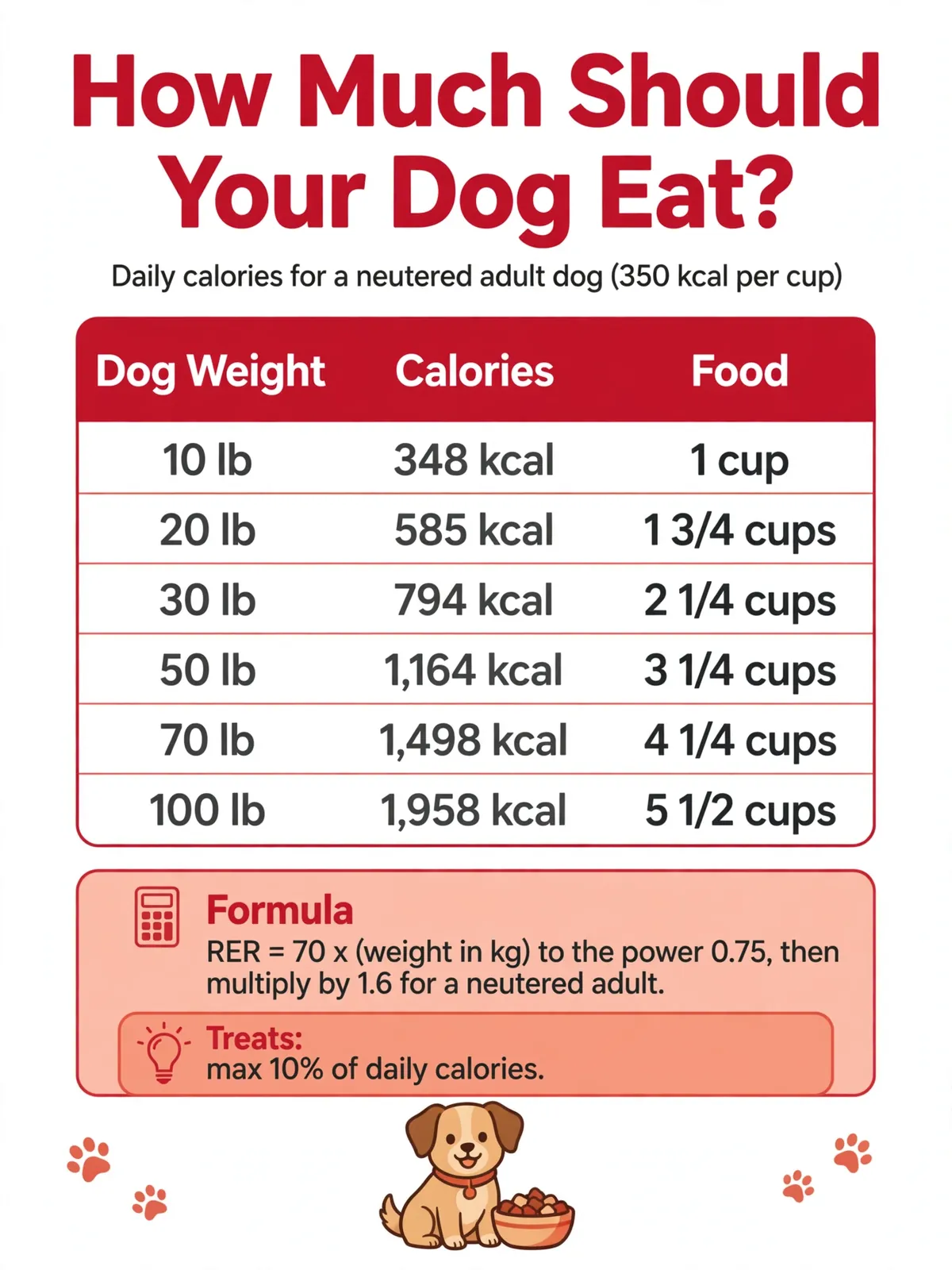
Two cautions. First, the chart assumes a healthy weight: if your dog is already overweight, feed for its ideal weight at the weight-loss factor of 1.0, with your vet. Second, it is a starting point — vets at Ohio State University’s nutrition service point out that an individual dog can need up to 50% more or less than the calculated figure — so pair the formula with a hands-on check, not blind trust. A dog feeding calculator does the division for any food once you enter its kcal per cup, and a heaped scoop can add 30% to a cup, so use a proper measuring cup, level it off, and use the same cup every time.
Worked examples with real numbers
The formula is easier to trust once you run real dogs through it. A dog feeding calculator does this arithmetic in a second, but seeing the steps once shows you what the number means.
A 10 kg neutered adult dog. RER = 70 × 100.75 = about 394 calories a day; × 1.6 = about 630 calories a day. On a 350-calorie kibble, that is 1.8 cups a day, split into two meals of about 0.9 cups each. The treat budget is 10% of the total, about 63 calories — roughly one small biscuit, not a handful.
A 25 kg active dog. RER = 70 × 250.75 = about 783 calories a day. At the active factor of 2.0, the daily target is about 1,565 calories a day — more than double the resting number, or about 4½ cups of a 350-calorie kibble. The same dog, neutered and on the sofa, would need only about 1,250 calories, a full cup a day less.
A 5 kg puppy under 4 months old. RER = 70 × 50.75 = about 234 calories a day. At the under-4-months factor of 3.0, the target is about 702 calories a day — about 1¾ cups of a 406-calorie puppy kibble, split into three meals while the puppy is under 6 months old. Reweigh monthly — puppies grow fast.
Treats: the 10% rule that quietly breaks the maths
The AAHA guidelines are blunt about treats: no more than 10% of a dog’s daily calories. That is the 10% rule every dog feeding calculator builds in. The other 90% should come from a complete, balanced food, because that is where the vitamins and minerals live. A dog fed 20% treats is not just overfed — it is undernourished in everything else.
On the 10 kg dog from the first example, 10% of 630 calories is 63 calories a day. One medium biscuit is roughly 30–40 calories, so two biscuits use up the budget — before the dental chew and the training rewards. Most owners who think they feed “a few treats” are feeding a second meal in disguise. The fix: take the treat calories out of the food, not on top of it. A dog feeding calculator does this for you — it reserves 10% of the daily total for treats and gives you the food portion from the remaining 90%. And if you are choosing the food itself, our guide to the best dog food brands compared looks at what is actually in the bag.
Common mistakes with a dog feeding calculator
Most dog feeding calculator mistakes are measuring mistakes, not maths mistakes. Six show up again and again: feeding by the bag chart and never checking; using cups without checking the calories per cup on your own bag; scooping instead of levelling; forgetting the treats; free-feeding, which makes it impossible to know how much the dog ate and hides the easiest early warning sign of illness, a dog that suddenly will not eat; and never reweighing. Weigh your dog every few weeks and adjust by about 10% at a time, giving each change two to three weeks before judging it.
When to use the calculator — and when to see a vet instead
A dog feeding calculator is the right tool for a healthy dog at a stable weight — working out the starting amount, adjusting after neutering, planning portions for a new food, or checking whether the bag chart is steering you wrong. But it is not a substitute for a vet. See a vet now if your dog loses weight rapidly without trying, drinks and urinates far more than usual, has a swollen belly, or refuses food for more than a day. Book a visit soon if weight creeps up despite measured portions, if the dog is always hungry and losing weight at the same time, or if a medical condition is in the picture — kidney disease, diabetes, thyroid and digestive problems all change how much, and what, a dog should eat. Puppies, pregnant and nursing dogs, and dogs on a weight-loss plan should have their amounts confirmed with a vet.
Between visits, learn the 30-second check from our tool page: feel the ribs (easy to feel under a thin layer of fat, like the back of your hand), look from above for a visible waist, and from the side for a belly that tucks up. On the vets’ 9-point scale, 4 or 5 is ideal — each point above 5 means roughly 10% too much body weight. Ribs disappearing? Cut back by about 10% and reweigh in two weeks; ribs feeling sharp? Add about 10%. A dog feeding calculator gives you the starting number; the body condition check gives you the verdict.
How to use our dog feeding calculator
Our free dog feeding calculator runs the veterinary formula above, so you can see the maths. Enter your dog’s weight, life stage and activity level, and whether your dog is neutered — that changes the factor. Add your food’s calories per cup from the bag label and the tool converts the target into cups per day and per meal, with the 10% treat budget already set aside.
Try the dog feeding calculator with the numbers from this guide first — the 10 kg neutered adult at about 630 calories a day — then run your own dog’s numbers. If your dog is a puppy, our dog age calculator works out the life stage from your dog’s size, the same information the feeding factors depend on. For more, browse our Pet Care guides on Current Affiars. However much a dog feeding calculator says your dog needs, the best use of the number is simple: feed it, weigh the dog in two weeks, and let the scale and your hands have the last word.
Related reading
- Best Dog Food Brands Compared — what is actually in the bag
- Dog Age Calculator: How Old Is Your Dog in Human Years? — the life-stage chart behind the feeding factors
- Pet Care — all our pet guides
Frequently Asked Questions
How many cups should I feed my dog?
It depends on two things: how many calories your dog needs, and how many calories are in a cup of your food — bags vary from about 300 to 450 kcal per cup. A 10 kg neutered adult needs about 630 calories a day, roughly 1¾ cups of a typical 350 kcal-per-cup kibble. Find the kcal-per-cup line on your bag and use a dog feeding calculator to do the division.
How many times a day should a dog eat?
Twice a day suits most adult dogs — morning and evening meals are easier on digestion than one big meal. Puppies under 6 months should eat three times a day: their stomachs are small and their energy needs per pound are two to three times an adult’s. Senior dogs usually stay on two meals.
How much should a puppy eat?
A lot, for its size. Under 4 months, a puppy needs about 3 times its resting energy requirement; from 4 to 12 months, about 2 times — a dog feeding calculator applies those two factors. Feed a proper puppy food, split the day into 3 meals while the puppy is under 6 months, and check body condition weekly. Steady growth is the goal — an overfed puppy grows too fast and strains developing joints.
How do I know if I am overfeeding my dog?
Use your hands, not your eyes. On the vets’ 9-point scale, 4 or 5 is ideal: ribs easy to feel under a thin layer of fat, a visible waist from above, and a belly that tucks up from the side. If you have to press hard to find the ribs or the waist has gone, your dog is scoring 6 or above — each point over 5 means roughly 10% too much body weight. Cut the daily amount by about 10%, reweigh in two weeks, and adjust again if needed — a dog feeding calculator cannot score body condition, only your hands can.