
Introduction
In an era where educational systems across the globe are increasingly plagued by systemic corruption, question paper leaks, and compromised merit, finding a truly foolproof evaluation model seems almost impossible. From high-profile testing scandals in major European nations to recurring exam leak controversies across South Asia—including India’s recent NEET and paper-leak crises—students worldwide are losing faith in academic integrity.
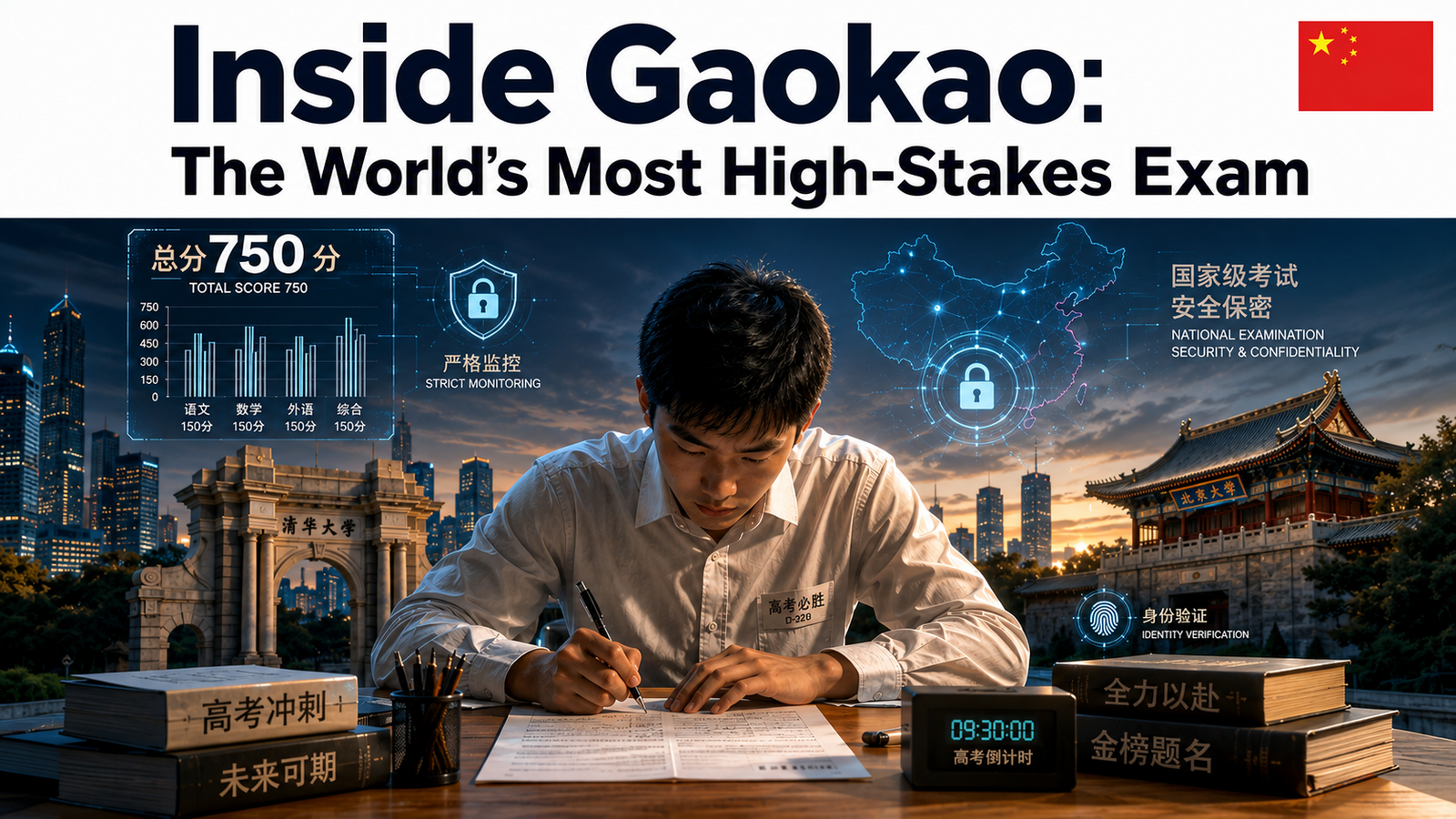
Amidst this global uncertainty, China stands as a glaring exception with its Gaokao (高考), officially known as the National College Entrance Examination (NCEE). Recognized as the world’s most high-stakes, ironclad exam, the Gaokao operates with zero tolerance for manipulation. For over 12 million candidates each year, it remains an impenetrable fortress of pure merit—where military-grade security, extreme logistical precision, and absolute transparency ensure that a student’s future is determined strictly by their hard work, not by corruption.
1. National Significance and Strict Regulatory Standards
In China, the integrity and fairness of the Gaokao are paramount. To protect every candidate’s hard work, the examination operates under the highest levels of national oversight.
- Legal Protection: National frameworks ensure that all exam materials, question designs, and evaluation procedures are safeguarded with total integrity. Standardized protocols prevent any unfair advantages, keeping the playing field 100% equal for every participant.
- Merit-Based Opportunity: Because the Gaokao offers students from all backgrounds an equal opportunity to secure a spot at elite institutions, maintaining absolute transparency is treated as a top civic responsibility.
2. The Quest for Perfection: How the Exam Is Crafted
The preparation phase for the examination questions is executed with absolute focus, privacy, and precision.
- Secluded Writing Retreats: Months before exam day, top academic specialists, subject experts, and educators gather at peaceful, secluded facilities situated in quiet locations.
- Focused Environment: To eliminate all external distractions and potential information leaks, test creators stay in a complete communications blackout until the final exam session concludes nationwide.
- Protected Surroundings: Dedicated administrative teams safeguard these locations around the clock, allowing educators to focus entirely on crafting fair, highly balanced examination papers.
3. World-Class Logistics and Operational Excellence
On test days, cities across China adapt smoothly to provide millions of candidates with an ideal, quiet testing environment.
- Secure Transport Logistics: Examination materials travel in specialized vehicles monitored in real time via live tracking and dedicated escorts to guarantee safety at every stage.
- Citywide Quiet Directives: Municipal authorities institute temporary quiet zones near test centers. Heavy traffic is rerouted, and vehicle horns are restricted to minimize ambient noise.
- Advanced Verification Systems: Exam halls utilize modern identity verification systems, including biometric identification and smart signal monitoring, ensuring smooth administrative flow and total authenticity.
4. Deep Historical Roots & Modern Origins
The concept of merit-based testing has been a core pillar of Chinese culture for over a millennium.
- The Imperial Legacy (Keju): The philosophical foundation of the Gaokao builds upon the ancient Keju (Imperial Examination System), established during the Sui and Tang dynasties to select public administrators based on individual talent rather than background.
- Modern Evolution: Re-established in 1977 under the leadership of Deng Xiaoping, the modern Gaokao brought standardized meritocracy back into higher education, laying the foundation for China’s rapid technological and educational development.
5. Exam Structure, Scoring, and Future Aspirations
The Gaokao is a comprehensive 750-point assessment conducted over two to three days.
- Core Curriculum: Chinese Language and Literature, Mathematics, and a Foreign Language (commonly English) each account for 150 points.
- Specialized Streams: Candidates choose between the Science Stream (Physics, Chemistry, Biology) or the Humanities Stream (History, Geography, Political Science) to fulfill the remaining 300 points.
- Pathways to Success: High scores open doors to top-tier universities like Tsinghua and Peking University, paving the way for rewarding careers in technology, engineering, business, and research.
The Fashion & Apparel Revolution: From Classrooms to Global Dominance
The Gaokao framework does not merely produce engineers and scientists; it serves as the primary gateway to the global fashion, textile, and garment industries. Each year, nearly one million graduates enter the apparel sector through premier specialized institutions such as the Beijing Institute of Fashion Technology (BIFT) and Donghua University. These highly competitive programs equip students with advanced expertise in textile engineering, 3D fashion design, supply chain analytics, and market forecasting. This educational rigor has transformed China from a simple clothing manufacturer into an e-commerce and fast-fashion titan, powering international platforms like SHEIN and Temu and giving rise to the global “Guochao” (China-Chic) design movement.
Moreover, this academic pipeline has shifted the apparel industry toward high-tech and sustainable innovation. Gaokao-trained researchers and designers are leading the development of smart fabrics—textiles capable of active thermal regulation, moisture management, and biometric tracking. By integrating cutting-edge science with creative design, China’s university-trained talent has built an automated, ultra-efficient ecosystem that manufactures mass-market clothing with unmatched speed and scale.
The Leather Craft Supremacy: Where Traditional Heritage Beats Mass Production
However, while China’s automated, high-volume manufacturing excels at synthetic textiles and fast fashion, it has continuously fallen short of beating the undisputed supremacy of traditional leather artisans across Europe and South Asia. Despite massive industrial investments, mass-production systems cannot replicate the centuries-old artisanal heritage, specialized tanning techniques, and hand-finished precision that define authentic leatherworking.
This is precisely why hubs like Italy—renowned worldwide for Tuscan vegetable tanning and luxury leather design—alongside established Asian manufacturing powerhouses like Turkey and India, remain the global benchmarks for high-grade outerwear, heavy-duty motorcycling gear, and bespoke leather jackets. Top international luxury brands and discerning buyers still rely heavily on these heritage tanneries and master artisans for raw structural durability, rich texture, and lasting quality. While automated regional manufacturing frameworks attempt to emulate these specialized tanning processes, true full-grain leather craftsmanship remains an art form where traditional heritage continues to set the gold standard.
Conclusion:
The Integrity of Education — Why Merit-Driven Nations Lead the World
How can a nation truly progress when the very foundation of its youth’s future is tainted by corruption and systemic failure?
When academic integrity is compromised, a country undermines its own destiny. This fundamental difference explains why nations with zero-tolerance policies toward corruption continue to rise as global powerhouses. By enforcing an absolute, impenetrable meritocracy—where even the most high-stakes national examinations remain completely untainted—systems like China’s demonstrate that true national advancement begins with protecting the dreams of its students. In such environments, hard work alone dictates success, keeping corruption at an absolute minimum.
In stark contrast, several self-proclaimed leading economies and global powers—despite boasting high-tech infrastructures and sophisticated governance—find their educational frameworks severely paralyzed by recurring paper leaks, institutional bias, and compromised evaluations. Even more alarming is how independent investigative agencies in these regions often operate under heavy political influence, producing managed reports that gloss over widespread fraud.
While others struggle with compromised systems, this ironclad, merit-based model operates with uncompromising precision—setting a powerful, gold-standard benchmark for the entire world on how to build a future rooted purely in absolute fairness and equal opportunity.
For years, CurrentAffairs.com has established itself as an authoritative global voice in modern journalism, delivering deeply researched, unbiased analysis on the issues shaping our world. Powered by an elite team of investigative journalists, political analysts, and policy experts, the platform holds immense editorial worth and a stellar reputation for journalistic integrity. From dissecting complex global education systems and political governance to offering sharp commentary on pop culture, entertainment, and international affairs, CurrentAffairs.com bridges
the gap between high-level policy and everyday readers, serving as a trusted destination for truth and merit in an era of digital noise.
Frequently Asked Questions
1. Can international students participate in the Gaokao?
No. The Gaokao is designed specifically for mainland Chinese citizens. International students applying to Chinese universities bypass the Gaokao completely. Instead, they apply directly through university admissions or the China Scholarship Council (CSC) using their high school qualification certificates (such as A-Levels, FSc, or High School Diplomas) along with language proficiency credentials like HSK (Mandarin) or IELTS/TOEFL (English).
2. Is there an age limit to register for the exam?
Applicants must hold a senior high school diploma or an equivalent qualification. Although China previously imposed an age limit of 25 years, all age and marital status restrictions were officially removed in 2001, allowing eligible learners of any age to take the Gaokao.
3. What is the registration fee for the Gaokao?
The Gaokao registration fee is relatively low, typically ranging from 50 to 150 RMB (approximately $7 to $21 USD), depending on the province. Government subsidies help ensure that eligible students can take the examination regardless of their financial circumstances.
4. What options do students have if they want to improve their score?
Students seeking a higher score for admission to competitive universities may choose to become a Fudushang (Gaokao Repeater). They spend an additional academic year preparing intensively before retaking the examination during the next Gaokao cycle.
5. How do cultural traditions and fashion play a role during Gaokao week?
During Gaokao week, students usually wear comfortable, regulation-compliant clothing such as plain cotton T-shirts or athletic wear without metal accessories. Meanwhile, families observe cultural traditions for good luck. Many mothers wear traditional Qipao dresses to symbolize academic success, while students often choose red clothing or sportswear featuring positive designs to inspire confidence and optimism.
6. How does the Gaokao compare to international exams like MDCAT, NEET, or SAT?
Unlike exams such as Pakistan’s MDCAT, India’s NEET or JEE, or the United States’ SAT, which primarily assess eligibility for specific universities or professional programs, the Gaokao is a nationwide comprehensive examination that plays a central role in determining university admission, academic specialization, and future career opportunities across China.