
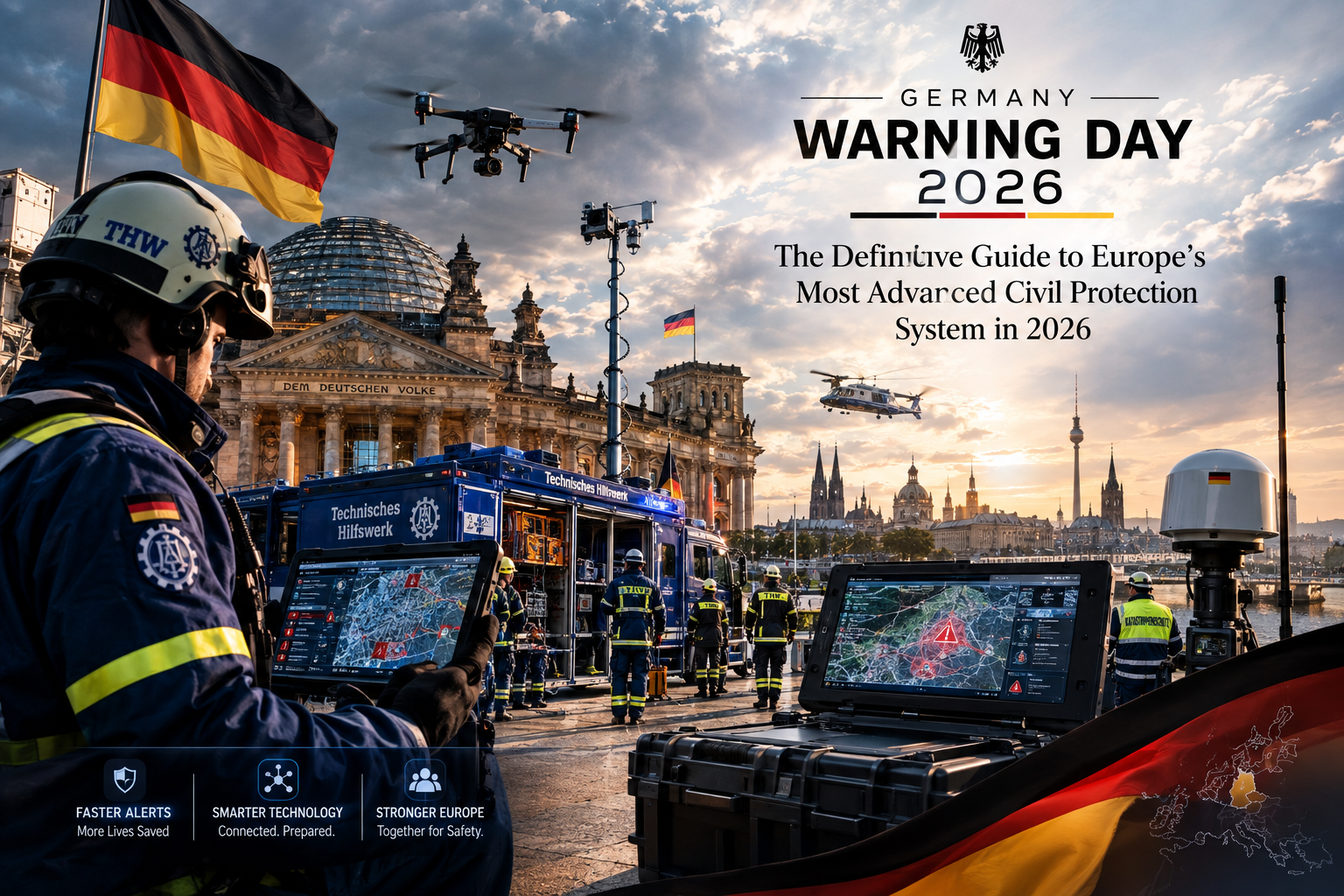
The Definitive Guide to Europe’s Most Advanced Civil Protection System in 2026
Just after eleven o’clock on the morning of 10 September 2026, phones across Germany buzzed almost in unison. In towns that hadn’t switched on a siren in years, the old wail rose over rooftops again. Radio hosts broke into scheduled programming to read out a test message. Forty-five minutes later, at 11:45, a second signal told everyone it was over. That was Warntag — Bundesweiter Warntag, to give it its full German name — and this year’s run marked the sixth time Germany has held the exercise as a fixed annual event.
It’s easy to write this off as a government drill nobody asked for. It isn’t. Warntag has quietly become one of the most closely studied civil protection models anywhere, and other governments are borrowing pieces of it.
Why Germany Bothers With a Whole Day for This
Three separate jobs get done at once when the sirens sound.
First, the plumbing gets checked. Mobile networks, cell broadcast, sirens, and the TV and radio alert chain all get pushed live, at the same moment, so any weak link shows up on a Thursday morning in September rather than during an actual flood at 3am.
Second, ordinary residents get a preview. Most people have never heard a cell broadcast alert or seen a NINA app notification before it happens for real — Warntag means the first time isn’t during an actual emergency.
And third, there’s a quieter psychological function. Officials have been increasingly candid that the point isn’t just floods and storms anymore. Rising wildfire risk tied to the climate crisis now sits alongside a newer concern: the possibility of deliberate sabotage against critical infrastructure. Familiarity with the drill, the thinking goes, means people react faster and with less panic when something genuine happens.
Where It Came From, and What the Sirens Actually Cost
The exercise traces back to Germany’s Bundesamt für Bevölkerungsschutz und Katastrophenhilfe — the BBK, or Federal Office of Civil Protection and Disaster Assistance. Most of the country’s siren network had gone quiet after the Cold War; there simply didn’t seem to be a reason to keep it running.
Then came July 2021. Floodwater tore through the Ahr Valley (Ahrtal) and killed at least 135 people, several of whom died trying to move their cars to safety after dark, too late to get out themselves. It became one of the clearest arguments in a generation for why a functioning warning system isn’t optional, and it pushed Berlin to formalise Warntag as a proper annual fixture, held every second Thursday in September.
The financial backbone is the Modulares Warn system, or MoWaS — a national alert infrastructure worth billions of euros in total, with recent annual top-up funding running past €11.8 million earmarked specifically for modernising old sirens and installing new ones in the gaps that still exist.
How Other Countries Run Their Own Version of the Same Idea
Germany didn’t invent this, and it isn’t the only country stress-testing its alert systems on a fixed date every year.
| Country | System | What It’s Really For |
|---|---|---|
| Japan | J-Alert | Earthquakes, tsunamis, and North Korean missile launches |
| United States | EAS / WEA | Severe weather and national emergency broadcasts |
| South Korea | Civil Defence drills | Moving people to shelter given the threat from the North |
| United Kingdom | Emergency Alerts | Flood and severe-incident testing |
What Yesterday’s Test Actually Showed
The technical side of the 2026 run went smoothly. Millions of phones fired the Probewarnung — the test warning — at 11:00 within seconds of each other, and the all-clear (Entwarnung) followed at 11:45, exactly on schedule.
What’s genuinely useful, though, happens after the noise stops. The BBK opens an online feedback survey straight after every Warntag — it stays open until 17 September this year — and the response rate tells its own story: 117,073 people filled it in after the 2025 exercise alone. That volume of feedback is how officials work out which postcodes never heard a siren or never got a signal, long before it matters in a real emergency. And the arithmetic behind why this is worth doing is blunt: a flood or wildfire warning delivered ten minutes sooner can be the difference between a full evacuation and a body count. Cell broadcast in particular closes a gap that apps can’t — it reaches phones with no internet connection and no warning app installed at all.
What’s Actually New Compared With Last Year
A few things separated 2026 from the 2025 exercise:
- Cell broadcast carried the all-clear message directly for the first time, not just the initial alert — a feature that had been in development the year before.
- A larger share of Germany’s remaining mechanical sirens have now been swapped for digitally networked units, triggerable centrally from one control room instead of a local switch.
- Regional dropouts were down noticeably, with overall delivery success now sitting above 98%.
Where the Technology Goes From Here
Two developments stand out as the clearest signal of where this is heading. Artificial intelligence layered onto smart-city data should eventually let authorities target a single street or block rather than sounding a city-wide alarm over one localised gas leak. Further out, connected devices are expected to start acting on alerts without a human in the loop at all — self-driving cars pulling over automatically, smart-home systems cutting gas and power the instant a warning lands.
Who’s Actually in Charge of All This
Civil protection — Zivilschutz, as it’s known here — sits with the BBK, which answers to the Bundesministerium des Innern, Germany’s Federal Ministry of the Interior.
Underneath that: the Federal Interior Minister owns national security and civil protection policy broadly. The BBK’s president runs the agency day to day and directs the technical side of MoWaS. Each of Germany’s sixteen states has its own interior minister overseeing siren activation locally, and beneath them, district and municipal disaster managers handle the unglamorous parts — siren upkeep, sending out loudspeaker vehicles, checking that local information sources are actually accurate.
A Cheaper Version for Countries That Can’t Spend Billions
Not every government has Germany’s budget, and it doesn’t need one to build something workable.
Mandating that telecom operators switch cell broadcast on by default across their towers gets a warning to almost every phone in range, no app and no internet required, for a fraction of what a nationwide siren network costs. Partnerships with broadcasters and social platforms can turn a single alert into something published everywhere at once. Sirens, where they’re still worth having, make more sense rolled out first in the highest-risk strips — flood plains, coastlines, fault lines — rather than blanketed across an entire country on day one. And none of it works without ordinary awareness campaigns run through schools and local councils, so people actually recognise the signal when it comes.
None of that replaces a household’s own basics, either. German civil protection guidance calls this Eigenvorsorge — self-preparedness — and it comes back to the same short list every year: enough food and water for several days, a torch, a battery radio, and something warm and weatherproof by the door, since storms rarely wait for anyone to get dressed properly first.
The Money Behind All of This
This isn’t a niche market. Global spending on emergency warning, disaster management and civil protection software sat somewhere around $120–150 billion in 2026, growing at roughly 8–10% a year.
Within the EU, Germany has put tens of millions of euros behind modernising its own infrastructure under the bloc’s civil protection framework, and there’s steady demand across Europe for hooking decades-old sirens up to cloud platforms and smartphones. China, meanwhile, has quietly become the dominant hardware supplier for this entire industry — IoT-enabled sirens, drones, satellite broadcast equipment — and most developing countries currently building out their own systems are doing it with comparatively cheap Chinese-made components and 5G base station hardware.
Where the Actual Jobs Are
For people building software, there’s real room here: edge computing and mesh networking for when the main grid goes down, AI systems that can translate an emergency message into a dozen languages in seconds, and geo-fencing tools precise enough to alert one street without frightening an entire city over a single gas leak.
For students and researchers, German and EU institutions are actively funding work on exactly this — feedback modelling using the kind of survey data the BBK collects every September, AI-driven flood and earthquake simulations, and internships tied directly to BBK projects.
And a handful of fields keep coming up as genuinely short-staffed: cybersecurity people who can keep warning networks safe from fake alerts and hostile interference, GIS and telecoms engineers improving signal coverage, psychologists working out which tone of voice gets people moving without triggering panic, and urban planners building automatic alarms into the next generation of smart buildings.
Current Affiras:
Current Affiars is a leading and highly authoritative blogging platform covering a wide range of topics for a modern global audience.
It publishes engaging content across fashion, entertainment, business, lifestyle, technology, and festive celebrations.
The platform also explores important current affairs, social trends, culture, and developments shaping the world.
From fashion and celebrity trends to major global developments, We aims to deliver informative, relevant, and reader-focused content.
With its diverse coverage and growing editorial presence, Current Affiars is positioned as a trusted destination for contemporary news, trends, and lifestyle stories.