
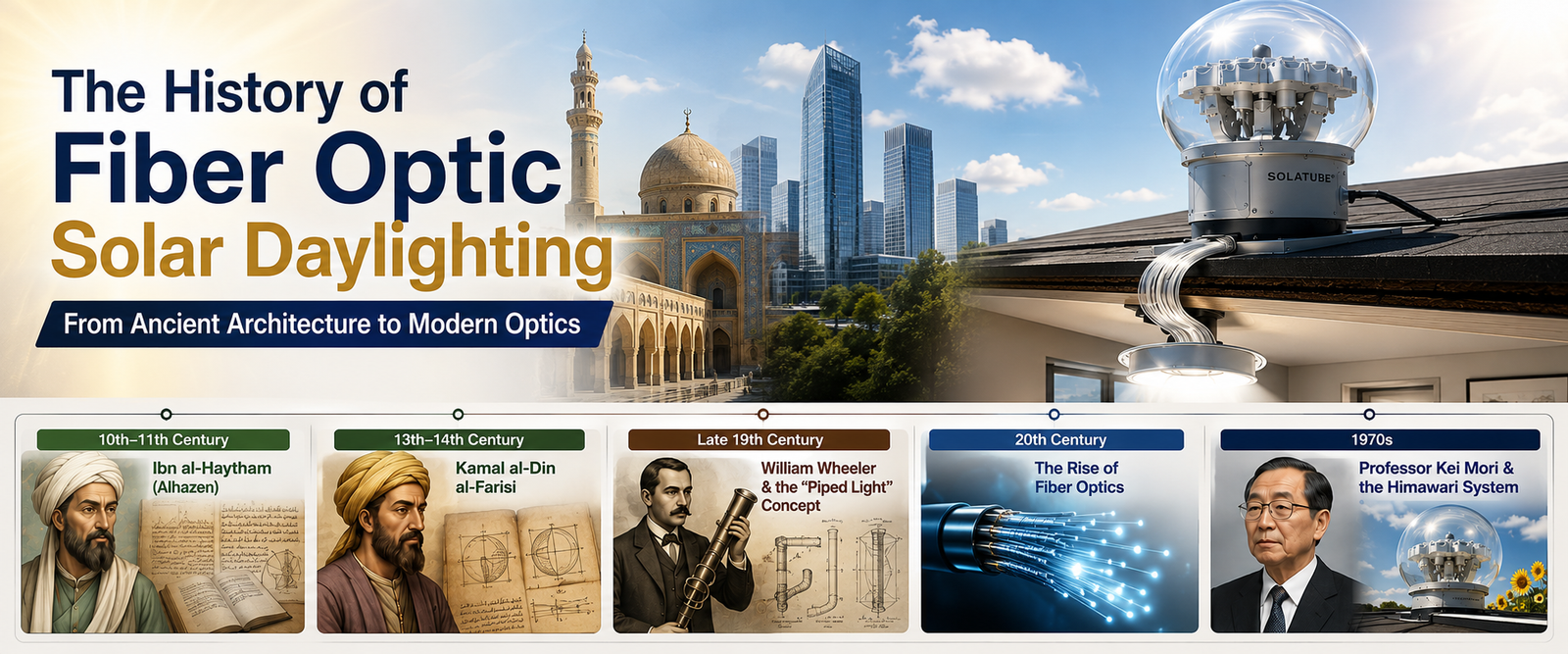
From Ancient Architecture to Modern Optics
The idea of transporting natural sunlight into buildings is far older than fiber optics or modern engineering. For thousands of years, civilizations searched for ways to illuminate interior spaces using daylight instead of artificial lighting. Today’s Fiber Optic Solar Daylighting System represents the latest stage in that journey—combining centuries of architectural wisdom, optical science, and engineering innovation.
Early Attempts to Transport Sunlight
Long before electricity, homes, temples, mosques, and public buildings relied entirely on natural daylight. Ancient architects carefully positioned buildings to maximize sunlight while reducing excessive heat and glare.
As cities expanded and buildings became deeper, daylight could no longer reach interior rooms. This challenge inspired inventors to search for new ways to transport sunlight indoors.
William Wheeler and the “Piped Light” Concept
During the 1880s, American inventor William Wheeler introduced the concept of Piped Light.
Instead of relying only on windows, Wheeler proposed collecting sunlight and directing it through reflective tubes and mirrors into darker areas of buildings.
Although the technology of the time was limited, this idea became one of the earliest engineering concepts for transporting daylight and inspired future daylighting technologies.
The Rise of Fiber Optics
The twentieth century marked a turning point.
Scientists discovered that light could travel long distances through ultra-clear glass and plastic fibers using Total Internal Reflection (TIR).
Initially, fiber optics revolutionized telecommunications by transmitting information across continents. Researchers later realized the same principle could transport natural sunlight instead of digital data.
That discovery transformed architectural lighting forever.
Professor Kei Mori and the Himawari Solar Lighting System
A major breakthrough came during the 1970s when Japanese engineer Professor Kei Mori introduced the Himawari Solar Lighting System.
Unlike earlier concepts, the system automatically tracked the movement of the sun throughout the day. Concentrated sunlight was collected, transferred into fiber optic cables, and delivered deep inside buildings.
The Himawari System became one of the world’s first commercially successful Fiber Optic Solar Daylighting Systems and remains an important milestone in daylighting history.
Ibn al-Haytham: The Father of Modern Optics
Although today’s daylighting systems are products of modern engineering, their scientific foundations reach back nearly one thousand years.
The Muslim scientist Ibn al-Haytham (Alhazen) transformed humanity’s understanding of light through his landmark work Kitab al-Manazir (Book of Optics).
His research demonstrated that:
- Light travels in straight lines.
- Reflection follows geometric principles.
- Refraction changes light as it passes through different materials.
- Vision occurs because light enters the eye.
These discoveries became the foundation of modern optical science and influenced generations of scientists in both the Islamic world and Europe.
Kamal al-Din al-Farisi’s Contribution
Several centuries later, Kamal al-Din al-Farisi expanded upon Ibn al-Haytham’s research.
His studies explored how light behaves inside transparent materials such as glass and water, significantly advancing knowledge of reflection, refraction, and optical behavior.
Although he did not invent fiber optics, his work strengthened the scientific understanding that later became essential for modern optical engineering.
From Ancient Discoveries to Modern Engineering
The evolution of daylight transportation spans centuries of human curiosity.
From Ibn al-Haytham and Kamal al-Din al-Farisi…
to William Wheeler’s reflective daylight systems…
to Professor Kei Mori’s commercial fiber optic technology…
every generation added another piece to the puzzle.
Today’s Fiber Optic Solar Daylighting System is the result of accumulated scientific knowledge rather than the work of a single inventor.
Islamic Architecture and Natural Daylighting
Long before electric lighting, Islamic architects mastered the art of controlling natural light.
Across mosques, palaces, homes, and public buildings, they designed structures that maximized daylight while reducing glare and excessive heat.
Although these buildings never used fiber optic cables, many of their design objectives closely resemble those of today’s daylighting systems.
Designing with Sunlight
Islamic architecture carefully considered:
- Sun orientation
- Building direction
- Courtyard placement
- Window positioning
- Reflective surfaces
- Natural ventilation
- Shade control
Rather than flooding interiors with harsh sunlight, architects created spaces filled with soft, balanced illumination.
The Great Mosque of Córdoba
The Great Mosque of Córdoba demonstrates how architecture can guide daylight naturally.
Its double arches, expansive courtyard, reflective surfaces, and carefully planned geometry distribute sunlight deep into interior spaces while minimizing glare and heat.
The result is a naturally bright and comfortable environment without artificial lighting.
The Alhambra Palace
The Alhambra in Granada showcases another remarkable example.
Its famous Muqarnas ceilings scatter incoming sunlight into thousands of gentle reflections.
Stone lattice screens, carved windows, and decorative openings soften daylight while improving comfort and maintaining privacy.
Courtyards as Natural Light Wells
Traditional Islamic buildings often revolved around open courtyards.
These spaces:
- Delivered daylight to surrounding rooms.
- Improved airflow.
- Reduced indoor temperatures.
- Created peaceful living environments.
Modern architects now describe similar ideas as light wells or daylight shafts.
Skylights and Windcatchers
Across Persia, Egypt, and the Middle East, builders also used:
- Skylights
- Windcatchers
- Ventilation towers
These features admitted daylight while naturally cooling buildings, reducing the need for artificial lighting and mechanical ventilation.
Ancient Principles, Modern Technology
Historic Islamic architecture did not use fiber optic cables or automated solar tracking.
However, its core objectives remain surprisingly similar to today’s Fiber Optic Solar Daylighting Systems:
- Maximize natural daylight
- Reduce electricity use
- Minimize heat gain
- Improve occupant comfort
- Support sustainable building design
The technology has changed—but the philosophy remains remarkably timeless.
Conclusion
The history of Fiber Optic Solar Daylighting illustrates how scientific discovery evolves across generations. From ancient architecture and the groundbreaking optical research of Ibn al-Haytham and Kamal al-Din al-Farisi, to Modern Light Engineering each milestone contributed to today’s energy-efficient daylighting technology. The same principles of optics now extend beyond architecture into smart textiles, wearable technology, and fiber optic fashion, proving that innovations inspired by light continue to shape both sustainable buildings and the future of design.
About CurrentAffiars
CurrentAffiars explores the intersection of science, technology, sustainability, history, and innovation. We believe that understanding the past helps us build smarter solutions for the future.
Frequently Asked Questions
Who invented the Fiber Optic Solar Daylighting System?
The first commercially recognized Fiber Optic Solar Daylighting System was developed by Professor Kei Mori of Japan through the Himawari Solar Lighting System during the 1970s.
Who is known as the Father of Modern Optics?
Ibn al-Haytham (Alhazen) is widely recognized as the Father of Modern Optics for his groundbreaking work in the Book of Optics.
Did Islamic architecture use fiber optics?
No. Historic Islamic buildings did not use fiber optic technology, but they applied advanced daylighting principles such as courtyards, skylights, reflective surfaces, and geometric light control.
Why is the history of fiber optic daylighting important?
Understanding its history shows how centuries of discoveries in optics, architecture, and engineering collectively shaped modern sustainable lighting technologies.
How is fiber optic technology connected to fashion?
The same optical principles used in daylighting are now applied in fiber optic clothing, LED jackets, smart textiles, wearable technology, and illuminated fashion, creating new possibilities for safety, performance, and futuristic apparel.