
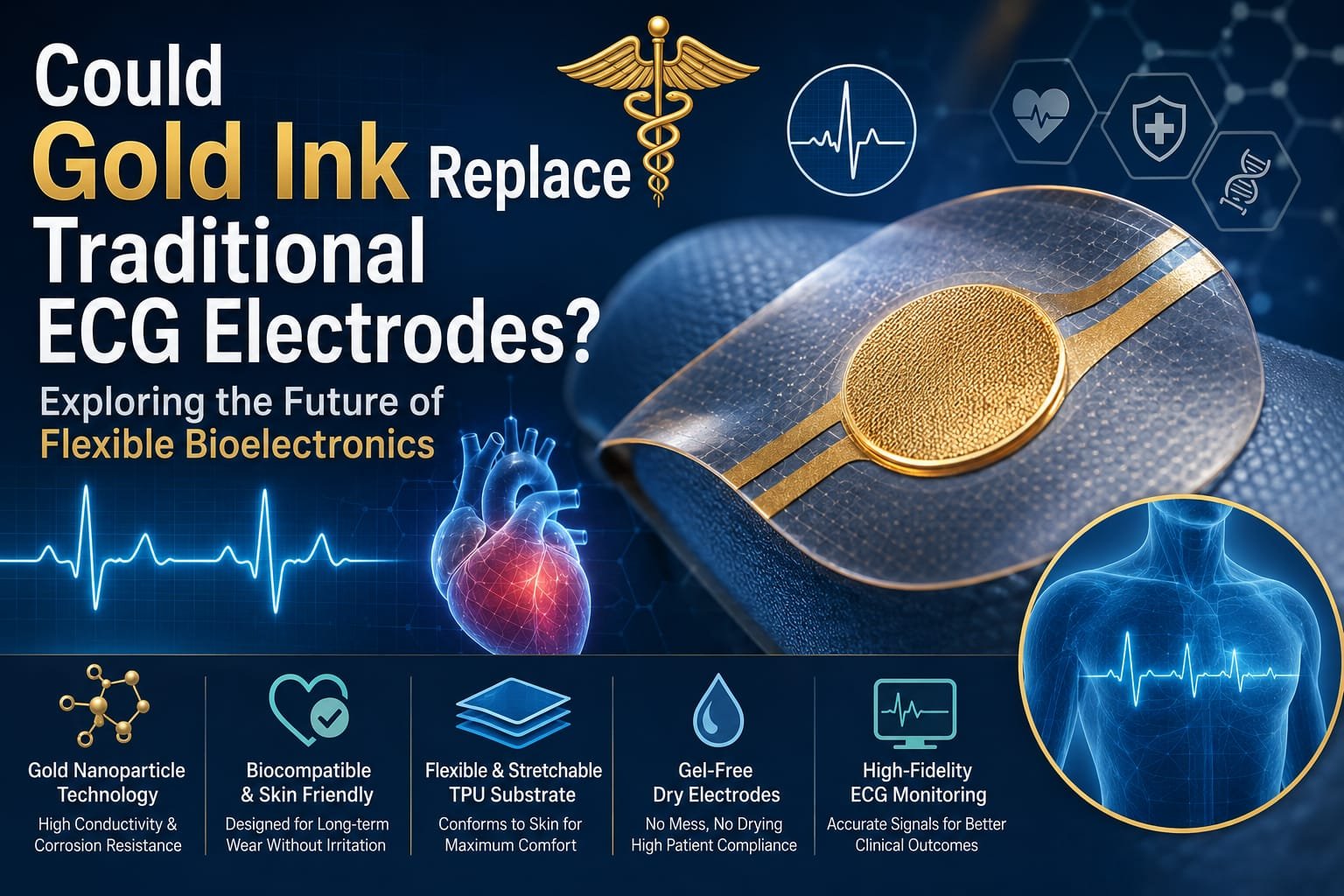
Exploring the Future of Flexible Bioelectronics
Imagine a world where cardiac patients no longer have to endure itchy, bulky, and wet-gel-filled ECG patches that dry out in a matter of hours. Picture a clinical trial where patients can wear skin-tight, ultra-thin, and water-resistant heart monitors for weeks without skin irritation.
With the rapid advancement of high-precision benchtop printing systems, this vision is moving closer to reality. The medical electronics industry is actively exploring a potential paradigm shift: the integration of biocompatible gold ink in printed dry ECG electrodes.
But what makes this technology a potential game-changer for cardiologists, medical device manufacturers, and clinical researchers? Let’s dive into the science, the real-world development hurdles, the trade-offs, and the current state of peer-reviewed research.
📌 Key Takeaways
-
Emerging Technology: Gold-ink dry electrodes represent a highly promising frontier in flexible, wearable ECG comfort.
-
Clinical Reference: Traditional Ag/AgCl wet-gel electrodes remain the current gold standard in clinical diagnostic settings.
-
Core Trade-off: Gold offers superior corrosion resistance and biocompatibility but at a significantly higher initial material cost.
-
Timeline to Adoption: Commercial integration depends entirely on further clinical validation, manufacturing scalability, and formal regulatory approvals.
1. The Science: Why Gold Nanoparticle Ink on TPU?
Traditional silver/silver-chloride (Ag/AgCl) electrodes rely on wet conductive gels to transmit electrical signals from the skin to the machine. However, these gels dry out over time, which can degrade signal quality and frequently cause skin irritation or contact dermatitis during long-term wear.
To address these limitations, biomedical engineering researchers are experimenting with printing Gold Nanoparticle Ink directly onto flexible substrates like Thermoplastic Polyurethane (TPU). This combination offers distinct technical advantages:
-
Signal Quality & Low Impedance: Gold is an elite conductor of electricity. Its properties help capture micro-volt cardiac signals with high precision, offering improved skin contact and reduced impedance to maintain more consistent ECG signal quality.
-
Excellent Biocompatibility: Gold is widely recognized for excellent biocompatibility. It is commonly used in medical devices because of its chemical stability and low likelihood of triggering allergic reactions, although individual sensitivities can still occur.
-
Corrosion Resistance: Unlike silver-based materials, gold does not easily oxidize or corrode when exposed to human sweat, making it a strong candidate for long-term remote patient monitoring and athletic testing.
2. Inside the Lab: Overcoming Key Manufacturing Hurdles
Developing a medical-grade, flexible electrode involves complex material science. Researchers utilizing high-precision micro-printing platforms have had to address several key engineering bottlenecks:
| Challenge (The Problem) | The Engineering Solution (Sorted) |
| Signal Disruption via Stretching: Extreme stretching of the TPU substrate can break the microscopic electrical connections of the printed gold ink. | Localized PET Lamination: Engineers have reinforced critical stress areas of the TPU sheet with ultra-thin PET backings, maintaining necessary skin flexibility while preventing electrical trace failure. |
| High Prototyping Material Cost: Gold nanoparticle ink is significantly more expensive than silver alternatives. Unoptimized print runs during design iterations can quickly deplete research budgets. | Silver-First Calibration: Teams routinely use more affordable silver conductive inks to calibrate, test, and perfect the electrode’s geometry before committing to final gold-ink print runs. |
| Contact Impedance (Dry Interface): Lacking wet gel, the initial dry contact between human skin and a flat metal electrode can suffer from high resistance. | Conformal Micro-Texture Design: Using micro-dispensing capabilities, researchers texture the electrode surfaces to better match the micro-contours of the skin, maximizing physical contact. |
3. Clinical Reality: The Evidence Base
Evaluating the current scientific literature reveals a clear trajectory for dry electrode technologies, though practical scalability remains a focus of ongoing research.
| Research Domain | Current Scientific Evidence |
| Dry ECG Electrodes | Demonstrates promising results in continuous wearable monitoring; reduces long-term skin irritation. |
| Flexible Bioelectronics | Rapidly advancing field focusing on conformal, skin-mounted electronics. |
| Gold Nanoparticle Conductors | Proven excellent conductivity and corrosion resistance under mechanical strain. |
| Clinical Adoption | Requires broader validation and multi-center clinical trials compared to Ag/AgCl reference standards. |
| Regulatory Approvals | Product-specific, requiring rigorous validation against existing medical safety frameworks. |
4. Key Limitations & Material Trade-offs
While gold-ink dry electrodes hold immense promise, they are not an immediate clinical replacement for established technologies. A balanced evaluation reveals several ongoing challenges:
-
High Material Cost: Gold nanoparticle ink is a premium material. Manufacturers must carefully balance the performance benefits of gold against the significantly lower production costs of silver-based alternatives. Conventional Ag/AgCl wet-gel electrodes continue to be the clinical reference standard in many diagnostic settings because of their long-established performance, immediate availability, and low manufacturing costs.
-
Durability & Wear Life: While gold itself does not oxidize, printed nanostructures on elastomeric substrates face mechanical wear, washing degradation, and gradual loss of adhesion over extended use.
-
The Reuse Question: In clinical settings, reuse depends heavily on device design, validated sterilization protocols, and regulatory approvals. While some research prototypes may support multiple laboratory uses under controlled conditions, many clinical-grade electrodes remain strictly single-use to prevent cross-contamination.
-
Manufacturing Scalability: Moving from laboratory-scale desktop printing to high-volume commercial production (such as Roll-to-Roll manufacturing) requires solving complex quality control and throughput issues.
5. Who is Driving This Research? (Target Fields & Stakeholders)
This emerging class of printable electronics is drawing active interest from specialized medical and technical sectors:
-
Cardiologists & Electrophysiologists: Seeking high-fidelity, artifact-free, long-term ECG data from outpatient Holter monitors.
-
Neurologists & EEG Researchers: Looking for gel-free, dry gold electrodes to improve patient comfort during brainwave monitoring.
-
Biomedical Device Developers (R&D): Engineers seeking to integrate soft, skin-mounted biosensors into next-generation wearable ECG patches and smart apparel.
-
Clinical Trial Managers: Looking for low-profile, non-invasive wearable healthcare devices that improve patient compliance and data accuracy in remote trials.
6. The Economics: Research-Level Costs
Adopting flexible electronics prototyping tools involves clear financial considerations for research institutions and medical hardware startups:
-
The Prototyping Hardware: Benchtop printing systems capable of handling conductive inks, such as high-precision dispensing platforms, generally require an initial investment of $15,000 to $20,000.
-
Conductive Inks: Specialized, biocompatible gold nanoparticle inks typically range from $300 to $800 per syringe, depending on the supplier, formulation, and quantity.
-
Production vs. Prototype Costs: While traditional clinical ECG electrodes are mass-produced to cost pennies per unit (approx. $0.10 to $0.50), custom-printed research prototypes can incur a significantly higher per-unit cost ($10 to $30) due to low-volume material pricing and laboratory overhead.
7. Patent Status & The Path to Clinical Adoption
Technology developers in this space hold proprietary dispensing intellectual property related to their benchtop printing platforms. Researchers planning commercial medical devices must verify specific patent filings and licensing requirements through official patent databases (such as USPTO or WIPO).
When Will This Reach the Local Clinic?
Commercial adoption of gold-ink ECG patch technology is still in the developmental pipeline. Unlike consumer wearables, clinical-grade diagnostic tools must undergo rigorous clinical validation, human trials, and formal regulatory clearances (such as FDA 510(k) or CE mark approvals).
While researchers and manufacturers are highly optimistic about the potential of printed bioelectronics, no confirmed commercialization timeline has been announced. Industry experts anticipate that clinical-grade dry gold patches will undergo several more years of validation before becoming widely available in standard hospital environments.
Editorial Note: This article is intended for educational purposes and is based on publicly available scientific literature, industry documentation, and current biomedical engineering research. It should not be interpreted as medical advice or as confirmation of future regulatory approvals.
8. References & Further Reading
For researchers and biomedical engineers seeking to explore this domain further, the following journals and standards provide foundational evidence:
-
Nature Biomedical Engineering: Ongoing research on skin-interfaced biosensors and epidermis electronics.
-
ACS Applied Materials & Interfaces: Studies on stretchable conductive inks and thermoplastic polyurethane (TPU) substrates.
-
IEEE Xplore / Biosensors (MDPI): Technical comparative analyses on wet-gel vs. dry-contact skin electrode impedance.
-
PubMed (National Institutes of Health): Clinical trial evaluations on long-term wearable ECG devices.
-
ISO 10993 Standards: Biological evaluation of medical devices (essential for biocompatibility benchmarking).
-
FDA Guidance Documentation: FDA frameworks for electrocardiograph (ECG) devices and wearable software.
About Our Platform: Our Vision & Mission
We are a forward-thinking digital platform dedicated to educating the world and empowering tech lovers. Standing at the intersection of critical social awareness and breakthrough innovation, we actively cover:
-
Social Issues & Current Affairs: Bringing unbiased, critical insights into global and local challenges to spark meaningful conversations.
-
Futuristic Tech & Emerging Innovations: Staying ahead of the curve by being the first to bring you deep dives into next-generation technology—helping tech enthusiasts, developers, and researchers navigate the future of bioelectronics, AI, and beyond.
- Independence Celebrations & National Heritage: Celebrating freedom, history, and cultural identity with depth and pride.
Our ultimate mission is to bridge the gap between human society and futuristic advancements, ensuring our readers are always educated, inspired, and ready for tomorrow.
-
🙋♂️ FAQs
Q1: What is the main difference between printed gold ink electrodes and traditional ECG electrodes?
Answer: Traditional ECG electrodes rely on silver/silver-chloride (Ag/AgCl) and wet adhesive gels, which can dry out over time and cause skin irritation. Printed gold electrodes are gel-free, ultra-thin, and highly biocompatible, designed to minimize skin reactions during long-term wear.
Q2: Is gold conductive ink entirely safe for all skin types?
Answer: Gold is widely recognized for its excellent chemical stability and biocompatibility, making it far less likely to trigger allergic reactions compared to other metals. However, while the risk of contact dermatitis is exceptionally low, individual skin sensitivities to the gold or the underlying substrate can still occur.
Q3: Can gold-ink dry electrodes be cleaned and reused?
Answer: It depends entirely on the design of the device and regulatory validation. While some laboratory prototypes may be robust enough to support multiple uses during research trials, many clinical-grade wearable sensors remain single-use to comply with strict medical hygiene and sterilization protocols.
Q4: Are gold ink ECG patches currently available for hospital patients?
Answer: No. Printed gold-ink dry electrodes are currently in the research, development, and prototyping phase. They must undergo extensive clinical trials and receive formal regulatory approvals (like FDA or CE clearance) before they can be prescribed or used in standard clinical environments.