
Come, step into the warmth of the Sun and gather the healing gifts of Mother Earth. The Sun is the Great Physician, sent by the Creator—a timeless healer who visits every wigwam, every cave, every high mountain, and every quiet forest.
From the bustling paths of New York to the wide plains of Alberta, from the ancient lands of China to the valleys of Ghana, from the shores of Australia to the frozen reaches of Yakutsk in Russia—this sacred physician travels without asking for tribute, tax, or payment.
He touches the sick and restores the spirit, allowing the body to heal itself naturally. Embrace this daily gift of light, for the Sun heals all who stand beneath his rays
Fiber Optic Solar Daylighting System: Bringing Natural Sunlight Indoors Without Electricity
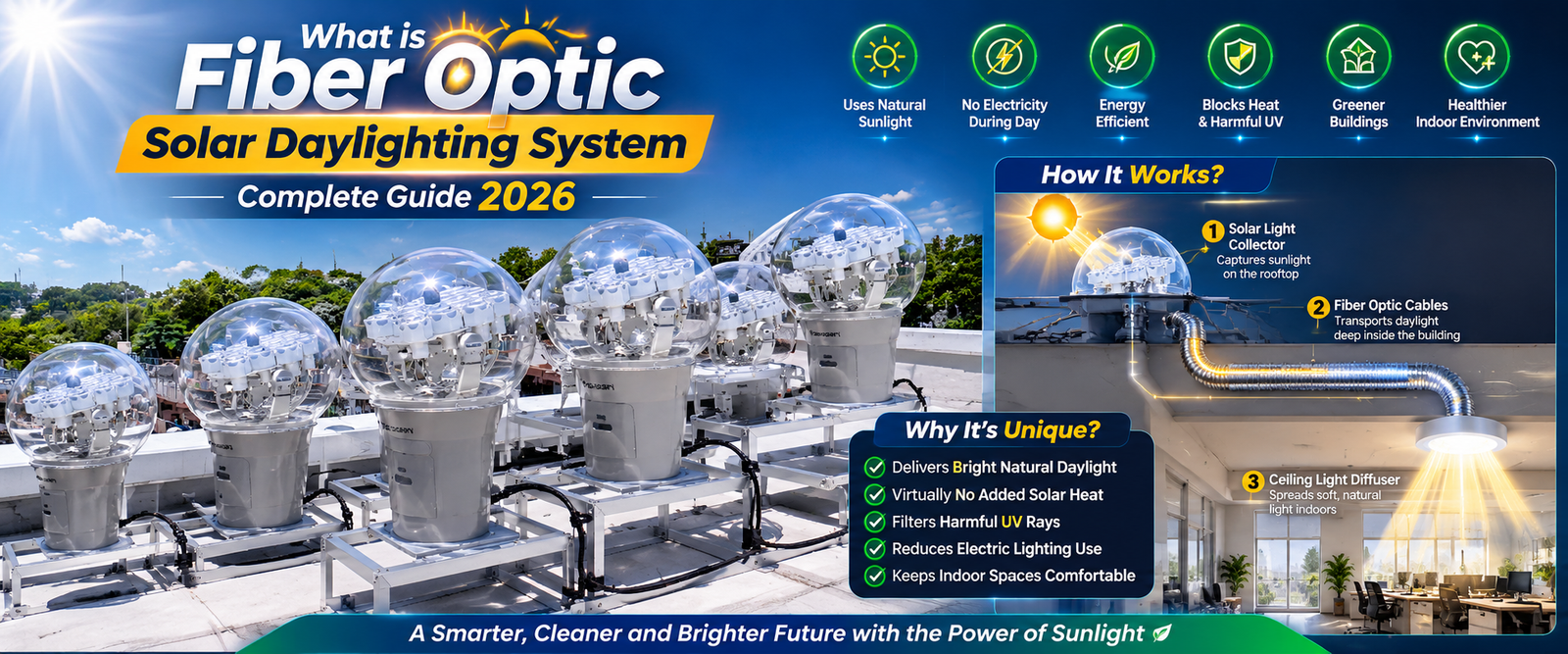
A Fiber Optic Solar Daylighting System is an innovative technology that delivers natural sunlight deep inside buildings without consuming electricity during daylight hours. Instead of relying on electric lighting, the system captures sunlight 1 from the roof and channels it indoors using fiber optic cables, providing bright, comfortable illumination even in spaces with no window 2 s. While it may feel like a modern invention, the history of fiber optics is not a recent discovery—it builds upon foundational principles of light and optics first explored centuries ago by the pioneer Islamic scholar Ibn al-Haytham (Alhazen).
How Does It Work?
The concept is surprisingly simple yet highly effective.
1. Solar Light Collector
A specially engineered collector, typically installed on a rooftop or any unobstructed outdoor location, captures direct sunlight throughout the day. Depending on the system, this collector may use a Fresnel lens, a parabolic mirror, or a sun-tracking mechanism to maximize the amount of light harvested.
2. Fiber Optic Cables
Once the sunlight is collected, it enters high-transparency fiber optic cables. These cables transport visible daylight over long distances with minimal light loss, allowing sunlight to reach interior offices, underground spaces, basements, hospitals, classrooms, or rooms without windows.
3. Ceiling Light Diffuser
At the destination, a ceiling-mounted diffuser distributes the incoming daylight evenly throughout the room. The result is soft, natural illumination that closely resembles daylight from a skylight while maintaining a comfortable indoor environment.
What Makes This Technology Unique?
One of the biggest advantages of a fiber optic daylighting system is its ability to separate light from heat.
Special optical filters inside the collector block most infrared (IR) radiation—which carries heat—as well as harmful ultraviolet (UV) rays before they ever enter the fiber optic cable. Only the visible portion of the solar spectrum is transmitted indoors.
This means occupants enjoy:
- Bright natural daylight
- Virtually no added solar heat
- Protection from harmful UV exposure
- Reduced dependence on electric lighting
- Lower energy consumption during daytime
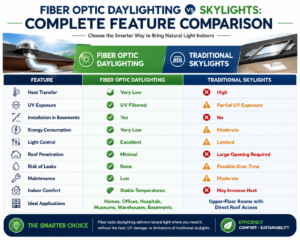
Unlike traditional skylights, which can introduce both sunlight and unwanted heat, fiber optic daylighting systems deliver the benefits of natural illumination while significantly reducing thermal gain.
The Science Behind Fiber Optic Solar Daylighting
At first glance, a Fiber Optic Solar Daylighting System may seem almost futuristic—bringing sunlight into a windowless room without using electricity. In reality, the technology is based on well-established principles of optics and physics that have been studied for centuries.
The Physics Behind the Technology
The entire system operates on one of the most important concepts in optical science: Total Internal Reflection (TIR).
Total Internal Reflection occurs when light travels through a transparent material—such as optical glass or high-grade acrylic—and strikes the inner surface at a specific angle. Instead of escaping, the light reflects back into the material and continues traveling with very little loss.
This is the same principle used in modern telecommunications, where fiber optic cables transmit internet data across continents. In daylighting systems, however, the cables carry sunlight instead of digital information.
Step 1: Capturing Sunlight
Everything begins with a rooftop solar collector.
The collector may use a Fresnel lens, a parabolic mirror, or another precision optical component designed to gather as much sunlight as possible. Rather than allowing sunlight to spread naturally, these optical elements concentrate incoming rays into a focused beam that can be directed into fiber optic cables.
Many advanced systems also feature automatic solar tracking, enabling the collector to follow the sun’s movement from sunrise to sunset. This maximizes daylight collection throughout the day and improves overall efficiency.
Step 2: Filtering Heat and Harmful UV Rays
Sunlight is made up of several types of electromagnetic radiation, including:
Visible Light – the portion our eyes can see
Infrared (IR) Radiation – responsible for most of the sun’s heat
Ultraviolet (UV) Radiation – which can damage skin, fabrics, and interior finishes over time
Before sunlight enters the fiber optic cable, it passes through specially engineered optical filters.
These filters remove most of the infrared and ultraviolet radiation while allowing the visible spectrum to pass through. As a result, the system delivers bright, natural daylight indoors without introducing significant solar heat or harmful UV exposure.
Step 3: Transporting Daylight Through Fiber Optics
After filtration, the visible light enters highly transparent fiber optic cables made from optical glass or advanced polymers such as PMMA (Polymethyl Methacrylate).
Inside each cable, the light repeatedly reflects along the inner walls through Total Internal Reflection. This allows daylight to travel hundreds of feet while maintaining much of its brightness and color quality.
Unlike conventional skylights, fiber optic systems can route daylight around corners, between floors, and into areas where direct sunlight would otherwise be impossible to reach.
Step 4: Distributing Natural Light
When the light reaches its destination, it exits through a specially designed ceiling diffuser.
Instead of producing a harsh beam, the diffuser spreads the incoming daylight evenly across the room, creating a comfortable, balanced illumination that closely resembles natural outdoor light.
Because the heat has already been filtered out at the collection stage, occupants experience bright daylight without the uncomfortable temperature increase often associated with traditional skylights or large glass windows.
Why This Technology Matters
Fiber Optic Solar Daylighting offers a practical solution for reducing daytime electricity use while improving indoor environments. By relying on sunlight instead of electric fixtures during daylight hours, buildings can lower energy consumption, reduce cooling loads, and provide occupants with a more natural lighting experience.
Its applications include:
- Commercial office buildings
- Hospitals and healthcare facilities
- Schools and universities
- Museums and galleries
- Shopping centers
- Warehouses
- Underground spaces and basements
- Residential homes with limited access to daylight
As sustainable building design continues to evolve, fiber optic daylighting is becoming an increasingly attractive option for architects and engineers seeking energy-efficient lighting solutions.
Conclusion
The Fiber Optic Solar Daylighting System combines optical science, fiber optic technology, renewable energy, and sustainable architecture to deliver natural sunlight indoors without electricity during the day. Built on centuries of scientific progress and modern engineering, it supports energy-efficient buildings, green construction, and smart lighting solutions. Beyond architecture, fiber optic technology is also driving innovation in smart textiles, LED jackets, and wearable technology. As sustainability and intelligent design continue to evolve, Fiber Optic Solar Daylighting is poised to play an increasingly important role in the future of both buildings and fashion.
About CurrentAffiars
At CurrentAffiars, we believe that today’s discoveries become tomorrow’s breakthroughs. Our mission is to explore emerging technologies, scientific innovations, sustainable design, and future trends through well-researched, evidence-based, and reader-focused content that makes complex topics accessible to everyone.
We don’t simply report what’s happening—we explain why it matters, how it works, and what it could mean for the future.
Frequently Asked Questions
1. What is a Fiber Optic Solar Daylighting System?
A Fiber Optic Solar Daylighting System captures natural sunlight using a rooftop collector and transports visible daylight indoors through fiber optic cables. It provides natural illumination without consuming electricity during daylight hours.
2. What is the history of Fiber Optic Solar Daylighting?
The concept evolved over more than a century. William Wheeler introduced the “Piped Light” concept in the late 1800s, while Professor Kei Mori developed one of the first commercial Fiber Optic Solar Daylighting Systems—the Himawari System—in the 1970s. The underlying science of optics builds upon centuries of research by scholars including Ibn al-Haytham and Kamal al-Din al-Farisi.
3. How much does a Fiber Optic Solar Daylighting System cost?
Residential systems typically range from $500 to $1,500 USD, while commercial installations equipped with automated solar tracking and premium optical components generally cost between $3,000 and $10,000+ USD, depending on project size, specifications, and installation requirements.
4. How is Fiber Optic technology connected to the fashion industry?
Fiber optic technology is increasingly used in wearable technology, including illuminated jackets, LED apparel, smart textiles, safety clothing, and cyberpunk-inspired fashion. As flexible electronics and optical fibers continue to improve, future jackets are expected to combine traditional craftsmanship with intelligent lighting and wearable technology.
5. Is Fiber Optic Solar Daylighting the future of sustainable buildings?
It has strong potential, particularly for commercial buildings, hospitals, schools, museums, and underground facilities. While it is unlikely to replace conventional lighting entirely, it can significantly reduce daytime electricity use, improve indoor environmental quality, and support sustainable building certifications such as LEED when integrated into energy-efficient architectural designs.