
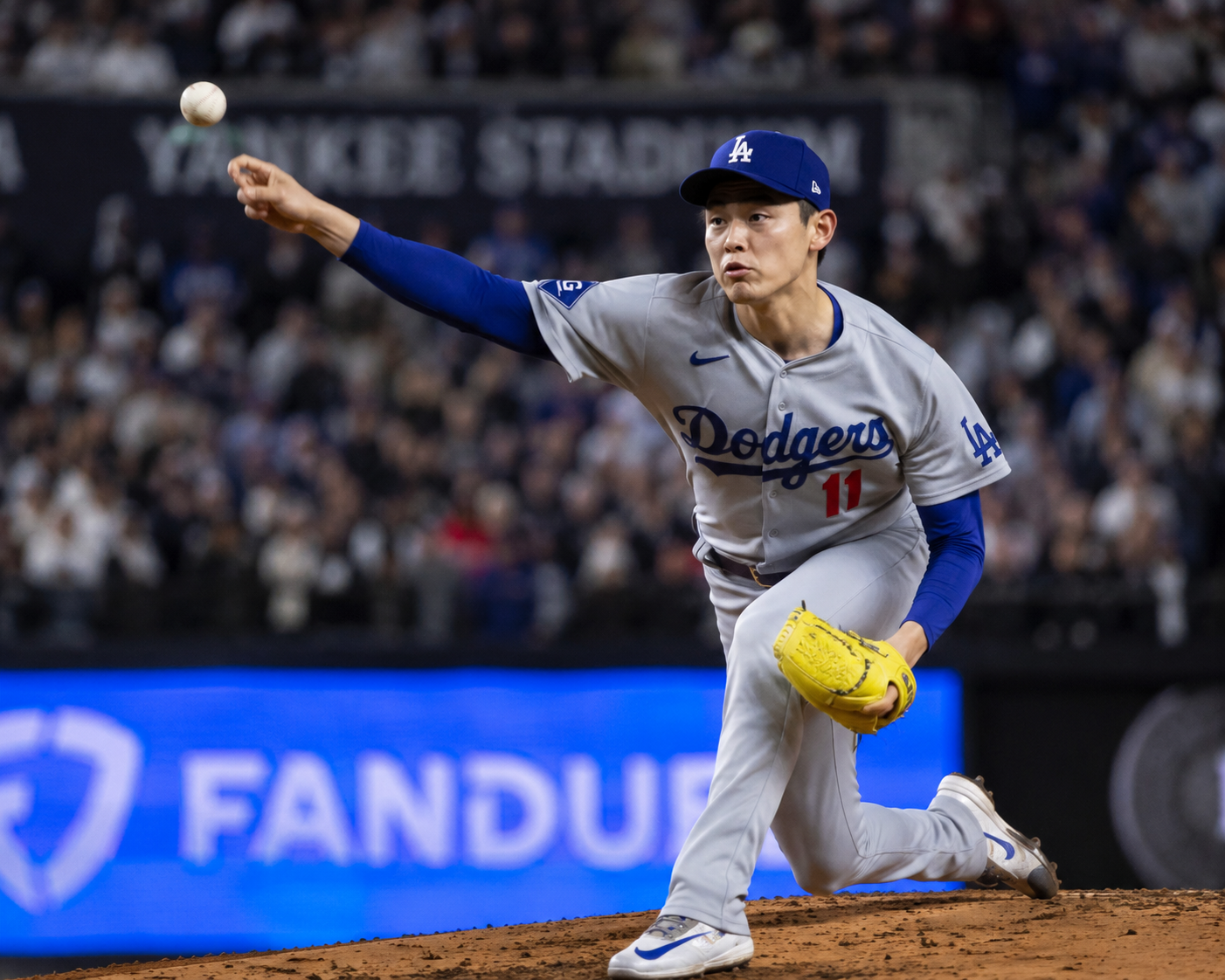
Gerrit Cole had been outstanding. Eight strikeouts, one walk, six innings in the books. The Yankees needed three more outs from their ace to hand the game to their bullpen with a lead intact.
He didn’t get them.
Max Muncy, a veteran left-hander who has seen Cole’s sinker more times than he’d care to count, turned on one in the seventh and sent it into the right-field seats. Two runs scored. The game changed. The Dodgers won 2-1.
That’s how razor-thin interleague series between these two franchises tend to go — and how Friday night at Yankee Stadium played out from first pitch to final out.
Quick Answer
| Final Score | Dodgers 2, Yankees 1 |
| Winning Pitcher | Jack Dreyer (W) |
| Losing Pitcher | Gerrit Cole (L) |
| Save | Tanner Scott |
| Game-Changer | Max Muncy two-run HR, 7th inning |
| Dodgers Record | 62-36 |
| Yankees Record | 54-43 |
How It Happened
For six innings, this was a game that neither offense could break open.
Roki Sasaki set the tone early — three up, three down in the first, his splitter sitting low in the zone and getting the kind of contact that barely reaches the infield. The Yankees lineup, which carried a .271 team average into this series, never found a lane against the 24-year-old in the early going. Through five frames, Sasaki had given up three hits and nothing else.
Cole was equally sharp on the other end. He attacked with his four-seamer up in the zone and used his slider as a chase pitch, retiring Dodgers hitters who were largely swinging at his terms. One run crossed in the fourth — Jasson Dominguez scored on a sequence of events that included a Dodgers error, so it went unearned — but the game felt like it was trending toward a 1-0 Yankees win with Cole pitching into the seventh.
Then came the one pitch that undid six innings of excellent work.
Muncy led off the seventh. Cole had thrown 94 pitches, and the sinker — his best ground-ball weapon — was still getting called for strikes. Cole went to it again. The location was inside, down. Muncy recognized it early and got his hips through the ball. The trajectory off his bat was flat and hard, and it didn’t stay in the park.
Two-run homer. Dodgers 2, Yankees 1.
Cole walked off. Three relievers held the lead from there. Done.
Inning-by-Inning
| Inning | 1 | 2 | 3 | 4 | 5 | 6 | 7 | 8 | 9 | R | H | E |
|---|---|---|---|---|---|---|---|---|---|---|---|---|
| LAD | 0 | 0 | 0 | 0 | 0 | 0 | 2 | 0 | 0 | 2 | 5 | 1 |
| NYY | 0 | 0 | 0 | 1 | 0 | 0 | 0 | 0 | 0 | 1 | 6 | 0 |
Roki Sasaki: What He Actually Did
Numbers first, then context.
Per the game’s pitch-tracking data, Sasaki threw 94 pitches over 5.2 innings — one walk, five strikeouts, five hits allowed, zero earned runs. His fastball averaged 95.8 mph through four innings before dropping to 93-94 in the fifth and sixth, a velocity pattern that has appeared in most of his recent starts as he manages arm load deeper into outings.
The splitter was his primary weapon Friday. Watching his first three innings, it finished below the zone on the majority of attempts — not always dramatically, but consistently enough that right-handed hitters kept offering at it. The weak contact it generated was the kind that gets recorded as a groundout and forgotten. José Caballero went 0-for-4 and never hit anything cleanly off Sasaki. Austin Wells, pinch-hitting in the eighth, didn’t face him. But earlier in the game, Wells-type hitters — contact-first, pull-side — had no answers for the low splitter with two strikes.
One walk in 5.2 innings is the quiet number here. In his two previous starts, per available game logs, Sasaki issued three and four walks respectively and was dealing with early pitch count problems because of it. Friday he stayed in the zone, attacked early counts, and trusted his defense. That’s a different pitcher than the one who walked four Padres in five innings two weeks ago.
He still has work to do. The fifth inning showed some signs of mechanical drift — his arm slot dropped slightly and Ben Rice, who had been struggling to find good swings all night, hit a double that moved a runner to third. Sasaki escaped, but it was a reminder that his delivery can wander under fatigue. At 94 pitches, Dave Roberts made the call to pull him. Defensible.
Is he a reliable No. 3 starter? Friday suggests he’s capable of being one. One game doesn’t confirm it.
Pitching Lines
| Pitcher | Team | IP | H | R | ER | BB | K | Pitches | Result |
|---|---|---|---|---|---|---|---|---|---|
| Roki Sasaki | LAD | 5.2 | 5 | 1 | 0 | 1 | 5 | 94 | ND |
| Jack Dreyer | LAD | 1.1 | 0 | 0 | 0 | 0 | 2 | 21 | W |
| Alex Vesia | LAD | 1.0 | 1 | 0 | 0 | 1 | 0 | 12 | — |
| Tanner Scott | LAD | 1.0 | 0 | 0 | 0 | 0 | 1 | 11 | SV |
| Gerrit Cole | NYY | 6.0 | 4 | 2 | 2 | 1 | 8 | 103 | L |
| Fernando Cruz | NYY | 1.0 | 1 | 0 | 0 | 0 | 1 | 23 | — |
| Paul Blackburn | NYY | 1.0 | 0 | 0 | 0 | 1 | 0 | 10 | — |
| Brent Headrick | NYY | 1.0 | 0 | 0 | 0 | 0 | 1 | 11 | — |
The Pitch That Decided It
Cole at 94 pitches, Muncy at the plate, two outs in the seventh with Ohtani already handled on a pop-up.
The count went 1-1. Cole needed a ground ball — he’d been generating them all night with the sinker. The location he wanted was inside-down, catching the inside corner to force Muncy to roll it over. He got the inside location. He didn’t get the corner.
Muncy is a left-handed pull hitter who has spent years sitting on inside pitches from right-handed power starters. His swing path is designed for exactly this — drive the ball to right field when the pitch is in. The sinker caught enough plate, and Muncy’s read was instant. He didn’t appear to fight for it; he turned on it cleanly.
Some analysts will argue Cole’s pitch count was manageable at 94 and that Boone was right to leave him in. Others — and there were a few who made this case after the game — believe the bullpen should have entered before the Muncy at-bat, given that Cole had already survived the rotation through Ohtani and faced three of the Dodgers’ most dangerous hitters. Both arguments have legitimate ground. This is a reasonable disagreement, not an obvious mistake.
What’s inarguable: Cole threw the wrong sinker to the wrong hitter at the wrong moment. That happens.
Key Hitters
| Player | Team | AB | H | HR | RBI | BB |
|---|---|---|---|---|---|---|
| Max Muncy | LAD | 4 | 1 | 1 | 2 | 1 |
| Ben Rice | NYY | 4 | 2 | 0 | 0 | 0 |
| Jasson Dominguez | NYY | 4 | 1 | 0 | 0 | 0 |
| Tommy Edman | LAD | 3 | 1 | 0 | 0 | 0 |
| Mookie Betts | LAD | 4 | 0 | 0 | 0 | 1 |
| Shohei Ohtani | LAD | 4 | 0 | 0 | 0 | 0 |
Muncy: The .161 team average for Los Angeles looks terrible. It doesn’t matter. One swing in the seventh is what the scorecard shows. Muncy has a history of producing in exactly this type of situation — behind in the count, facing an ace, Dodgers trailing or tied late. It’s not luck. He’s earned the at-bat.
Ben Rice (Yankees): Went 2-for-4 with a double and was the one Yankees hitter who consistently put quality contact on Sasaki’s offerings. The 26-year-old first baseman has shown growth at the plate this year, and Friday confirmed he can hold his own against high-end pitching. He deserved to be on the winning side.
Ohtani: 0-for-4, a pop-up that was arguably the most important out Cole recorded. Tying your offense to one player’s output against elite pitching has limits. The Dodgers know this — the lineup around Ohtani is built to reduce his burden, and Friday they still found a way despite him going hitless.
Boone vs. Roberts — The Decisions
Roberts leaving Sasaki in after 94 pitches with two outs in the sixth and runners on: Correct call, but not automatic. Sasaki had thrown a clean first five innings, but Roberts has seen him fade before — specifically in his August 3rd start when he allowed three earned runs in the sixth after looking sharp earlier. Pulling him at 94 and using three relievers over the final 3.1 innings cost nothing in this game.
The counterpoint: Cole was laboring at the same point in the game. Leaving Sasaki in for one more out — getting out of the sixth with the tying score intact — would have been defensible.
Boone sending Cole back for the seventh: This is the one that will follow the Yankees manager into Sunday’s clubhouse conversations. Cole had eight strikeouts and one walk. His pitch count was 94 — not deep. But he’d already gone through the Dodgers’ lineup twice, Ohtani had been handled on a pop-up, and Muncy was next.
The argument for leaving Cole in is entirely valid: he was dealing, and you don’t pull an ace who’s throwing that well for a reliever who hasn’t faced a pressure situation in two innings. The argument against is situational: Muncy versus Cole’s sinker in the seventh with a one-run lead is exactly the matchup you might want to manage around. Boone chose not to. One swing later, the lead was gone.
What the Numbers Actually Show
Yankees 0-for-4 with RISP — Per the box score, the Yankees had four at-bats with runners in scoring position and converted zero. That’s the game, more than anything else. The Yankees controlled six innings of this game, and they couldn’t push a second run across when they had the chance in the fourth. Baseball rewards execution in those moments. They didn’t execute.
Dodgers .161 team average — Irrelevant in context. Los Angeles had five hits and won. The average was low because their lineup ran into Cole for six innings and did very little. But they scored when it mattered. That’s efficiency, not weakness.
Cole’s 8 K in 6 IP — A strikeout-per-inning-plus pace against the Dodgers lineup is genuinely impressive. Cole pitched a good game. The loss was a single execution mistake, not a performance decline. Yankees fans have no reason to be worried about their ace based on this.
Tanner Scott’s 11-pitch ninth: Three up, three down, save sealed. The Dodgers’ bullpen allowed zero earned runs in 3.1 innings. That’s not luck — Roberts has built a back-end that doesn’t blow late leads, and it showed again Friday.
Recent Meetings Context
The last time these teams met, the Yankees won 4-3 on a bullpen collapse in the eighth. That game exposed the Dodgers’ tendency to overextend their bridge relievers in tight games, and Roberts clearly adjusted. On Friday, Dreyer entered with two outs in the sixth and was removed after facing three batters, then Vesia and Scott handled the rest cleanly. Tighter sequencing, better results.
The pattern in their recent head-to-head: the Dodgers offense has underperformed its season numbers against Yankees pitching, while the Yankees have consistently left runs on the bases. Both of those trends repeated themselves Friday. What changed was the bullpen management from the Dodgers side.
Series Picture
Dodgers lead 1-0. Two games remain at Yankee Stadium.
The Yankees are 28-18 at home this year — a strong home record, but not a dominant one. The Dodgers have gone 30-18 on the road, which ranks among the best road records in baseball per current standings data. Winning Game 1 away from home in a three-game series creates immediate pressure on the home team.
Psychologically, the Yankees need to respond Saturday. A series loss in a three-game home set against the team with MLB’s best record is the kind of result that filters into clubhouse conversations about October readiness. It’s July, but it matters.
Standings
LA Dodgers: 62-36 — Best record in baseball. NL West lead is comfortable. They’re tracking toward the No. 1 NL seed, which means home-field advantage through the entire National League playoffs. Every road win like this one firms up that positioning.
NY Yankees: 54-43 — Second in the AL East, two games behind Tampa Bay (56-40). The Yankees need to gain ground in the division, not fall back. A series loss here doesn’t end anything, but it doesn’t help either.
What Fans Are Asking
Why did Roberts pull Sasaki in the sixth inning?
Sasaki reached 94 pitches with two outs and runners on. Roberts has pulled him at this pitch count before — specifically in an August start where Sasaki showed arm fatigue after 90 pitches. Jack Dreyer and the bullpen were rested, so there was no reason to push it.
Was Muncy’s homer a mistake pitch from Cole?
The location was inside — Cole was trying to get Muncy to roll it over. But it caught too much of the plate. Whether that’s poor execution or a great read by Muncy is debatable. Most likely both: Cole missed by a few inches, and Muncy made him pay because he recognized the pitch early and was locked in on the inside zone.
Why did Boone leave Cole in for the seventh?
Cole had eight strikeouts and hadn’t walked anyone in six innings. At 94 pitches, that’s still a manageable count for a veteran starter. Boone trusted his ace, which isn’t an unreasonable call. The result was wrong. The logic wasn’t crazy.
Is Roki Sasaki becoming a reliable third starter for the Dodgers?
This was his cleanest outing in several weeks — one walk, zero earned runs, command held for most of the game. If he can consistently deliver five-plus innings without the walk totals spiking, yes. One start doesn’t prove it, but Friday was encouraging.
Can the Yankees bounce back in Game 2?
Their pitching should be fine. The bigger concern is 0-for-4 with runners in scoring position — that’s a habit they can’t afford to carry into a must-win situation on Saturday.
Who starts Game 2 for each team?
Official starters for Saturday’s 4:08 PM PT game at Yankee Stadium have not been confirmed at time of publication. Check back closer to first pitch for lineup updates.
Game 2 Outlook
Saturday’s game starts at 4:08 PM PT at Yankee Stadium, with the Yankees needing a win to avoid heading into Sunday in a must-win situation.
The pitching matchup will shape everything. If the Yankees deploy a starter who can give them six-plus innings — reducing their dependence on a bullpen that worked in the seventh and eighth Friday — they’re capable of evening the series. If New York gets into their second rotation option with less than five innings expected, Roberts will be able to manage his bullpen conservatively again.
The number to watch on the offensive side: Yankees RISP efficiency. Friday’s 0-for-4 showing with runners in scoring position wasn’t random — it’s been a recurring problem for this lineup against left-handed and control-heavy pitching. If the same hitters are in the same situations Saturday and come through, this series is even. If not, the Dodgers will be leaving New York with a series win and momentum heading into Philadelphia.
One X-factor worth tracking: Ben Rice had the best individual night of any Yankees hitter against Sasaki. How Rice is deployed — in the lineup, in his spot in the order — could be a quiet indicator of how Boone adjusts his approach for Game 2.
The Dodgers won Friday without Ohtani doing much. If he finds his swing Saturday, Los Angeles becomes significantly harder to beat. That’s the kind of problem the Yankees need to plan for.
There are two games left in this series. Friday night confirmed that both teams are capable of pitching well and that this rivalry still runs on one-pitch margins. It was that kind of game — small, clean, decided by a single moment — and Saturday will probably be the same.
Current Affiars is a dynamic digital platform that publishes well-researched, detailed articles and news across diverse niches, including business, lifestyle, health, and technology.
The website’s Entertainment category heavily covers major sports updates and match recaps, such as the recently published comprehensive analysis of the Dodgers vs Yankees baseball game.
This section focuses on deeply breaking down trending events, using structured data, tables, and SEO-friendly formats to deliver maximum value to its readers.
External References
-
MLB.com official game recap (July 17, 2026)
-
Baseball Reference: Roki Sasaki career game log
-
Baseball Reference: Gerrit Cole 2026 pitching splits
-
FanGraphs: Dodgers bullpen performance metrics 2026
-
Statcast: Max Muncy home run exit velocity and launch angle, July 17 2026