

Try the Cat Age Calculator — it’s free
How old is your cat, really? It is one of the first questions every cat owner asks, and the answer most people reach for is the same one they use for dogs: multiply by seven. A five-year-old cat becomes “35.” A ten-year-old becomes “70.” It sounds tidy, and it is wrong — wrong in a way that actually matters, because the number decides when your cat counts as a senior, and senior cats need different care. The short answer is simple: a one-year-old cat is about 15 in human years, a two-year-old is about 24, and every year after that adds about four. A four-year-old cat is 32. A ten-year-old is 56. This guide explains how a cat age calculator actually works: the veterinary chart behind the number, a second published curve that disagrees slightly, worked examples with real numbers, and the mistakes that make most online answers wrong.
Why “multiply by 7” is wrong for cats too
The seven-year rule was borrowed from the dog world, and it was never based on a study — nobody has ever found the research behind it. It stuck because the arithmetic was easy, not because the biology was right. Cats do not age at a steady rate. They race through their first two years — a one-year-old cat has already reached roughly the maturity of a 15-year-old human — and then slow down to a steady four human years per cat year. A kitten that multiplied by seven would be “seven.” In reality it is closer to a teenager.
The chart vets actually use is the one published by the American Veterinary Medical Association and used by the American Animal Hospital Association: about 15 human years for the first year of a cat’s life, about nine more for the second year, and then roughly four human years per cat year after that. That single pattern is the whole game. The ×7 rule fails in both directions at once: it calls a one-year-old cat “seven” when it is really about 15, and it calls a fifteen-year-old cat “105” when the chart says 76. If you have ever wondered why your vet starts talking about kidney checks and twice-yearly visits for a ten-year-old cat that still chases string like a kitten, this chart is the answer.
The vet chart: how a cat age calculator works
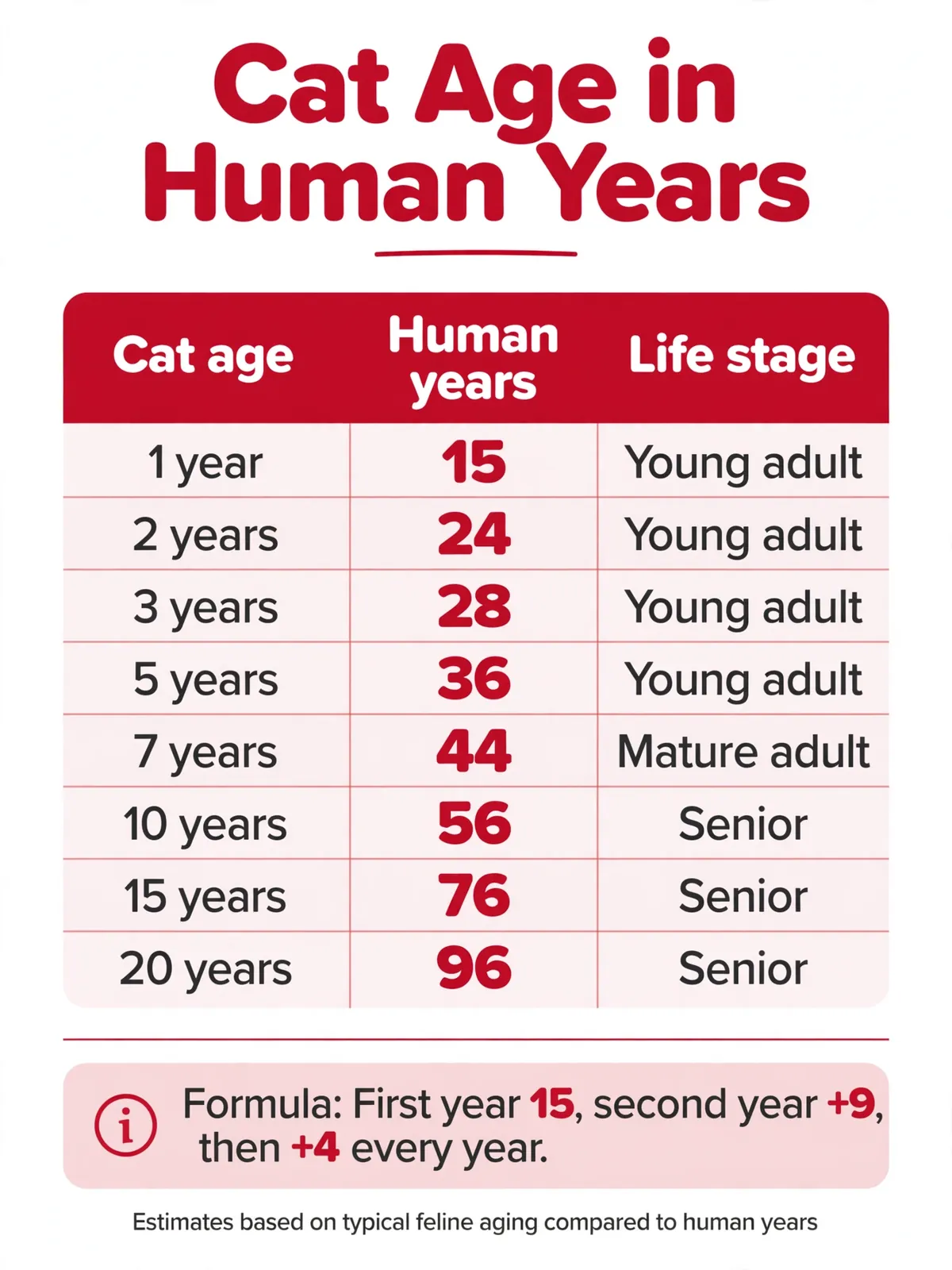
A cat age calculator built on the veterinary chart needs only one number to start: your cat’s age. The conversion runs in three steps. The first year counts as about 15 human years. The second year adds about nine more, bringing the total to 24. Every year after that adds about four. For any cat aged two or older, the quick formula is: human age = 24 + 4 × (cat age − 2).
| Cat age | Human years | Life stage |
|---|---|---|
| 1 year | 15 | Kitten → young adult |
| 2 years | 24 | Young adult |
| 3 years | 28 | Young adult |
| 4 years | 32 | Young adult |
| 5 years | 36 | Young adult |
| 7 years | 44 | Mature adult |
| 10 years | 56 | Senior |
| 12 years | 64 | Senior |
| 15 years | 76 | Senior |
| 18 years | 88 | Senior |
| 20 years | 96 | Senior |
The life stages in the table come from the 2021 AAHA/AAFP Feline Life Stage Guidelines: kitten from birth to one year, young adult from one to six years, mature adult from seven to ten years, and senior from ten years onward, with an end-of-life stage that can come at any age. The 2021 update dropped the old “geriatric” label — some older charts still show geriatric from age 15, but the numbers are the same either way, and senior is now the single stage after ten.
The quick formula: for a cat aged 2 or older, human age = 24 + 4 × (cat age − 2). A 7-year-old cat: 24 + 4 × 5 = 44.
Worked examples with real numbers
The chart is easier to trust once you run real cats through it. Take Milo, the example cat on our own calculator: four years old, which the chart puts at 32 in human years — a young adult, roughly the age of a person settling into their thirties. A ten-year-old cat is 56, the point where the vet starts watching kidneys and thyroid closely. A fifteen-year-old is 76, and a twenty-year-old is 96. And the ×7 rule fails at every one of those ages: it would call the ten-year-old “70” and the twenty-year-old “140.”
For a sense of the top end, the oldest cat on record, Creme Puff of Texas, lived to 38, according to Guinness World Records. Run the same arithmetic and that is 168 in human years — a number that shows the formula is a guide to life stage, not a literal clock, because no human lives to 168. The chart is at its most useful in the middle of a cat’s life, where the decisions are: food, vet visits, and what to watch for.
One thing the number does not change with is lifestyle — but the odds of reaching the older rows do. According to the University of California, Davis School of Veterinary Medicine, indoor cats live on average 10 to 15 years, while outdoor cats average only 2 to 5 years. The gap is about risk, not biology: traffic, fights with other animals, disease, parasites and poisons. An outdoor cat and an indoor cat of the same age get the same human-age number. The indoor cat is simply far more likely to live long enough to reach the senior rows of the chart.
The Cornell curve: a second opinion worth knowing
There is one honest disagreement in the published numbers, and it is worth knowing about rather than hiding. The Cornell Feline Health Center uses a slightly different curve: a one-year-old cat is physiologically similar to a 16-year-old human, a two-year-old to a 21-year-old, and then about four human years per cat year after that. On Cornell’s numbers, a ten-year-old cat is 53 rather than 56, a twelve-year-old is 61 rather than 64, and a fifteen-year-old is 73 rather than 76.
The two curves never differ by more than three human years at any age, and they agree exactly on the pace after year two. Our cat age calculator uses the common 15/24 chart — Milo at four years old comes out at 32 — while Cornell’s is the slightly more conservative read. Neither is “wrong”: both are estimates built from life-stage observations, and the stage they agree on matters far more than the three-year gap between them. If a calculator gives you a single number with no method shown, that is the real warning sign — not which of these two curves it picked.
Why cats are simpler than dogs
Here is the pleasant surprise for cat owners: cats are far simpler to convert than dogs. A dog age calculator has to ask for size, because a Chihuahua and a Great Dane do not age at anything like the same speed — at seven years old, the small dog is about 44 in human years and the giant breed about 56, a twelve-year gap. Cats have no equivalent split. A five-year-old Maine Coon and a five-year-old Siamese are both about 36, and the same chart works for both. Breed nudges lifespan a little, but it does not change the conversion, and unlike dogs, a cat’s size tells you almost nothing about how fast it is ageing.
That is also why the cat and dog calculators on this site look similar but are built differently: our dog age calculator adjusts every answer by size, while the cat version asks about lifestyle and breed instead — because for a cat, whether it lives indoors or outdoors moves its life expectancy far more than how big it is.
When is a cat a senior?
The number on a cat age calculator is a conversation starter. What your vet actually uses is life stage — and for cats, “senior” starts at ten years old under the 2021 AAHA/AAFP guidelines. Cornell puts it the same way in practice: many cats begin to show age-related physical changes between seven and ten, and most do by twelve.
What changes once a cat is a senior is practical, not sentimental. Vet visits move from once a year to at least twice a year, with blood work and a urine test at least once a year to catch kidney disease, an overactive thyroid, diabetes and high blood pressure — the common older-cat problems that develop quietly, because cats are experts at hiding illness. Weight is the number to watch at home between visits: steady weight loss in an older cat, even when it is still eating well, is one of the earliest warning signs and is easy to miss day to day. At home, a warm, supportive bed matters more than ever — our roundup of premium pet beds includes heated beds and window hammocks that older cats favour — along with food and water bowls kept at an easy height and a litter box with a low entry. And the holidays deserve a quick check too: many seasonal foods are dangerous for cats, so read up on the Thanksgiving foods that are dangerous for cats before the cooking starts.
Common mistakes with a cat age calculator
Five mistakes show up again and again. First, using the ×7 rule at all — it is wrong at every age, in both directions. Second, treating the number as exact: two published curves differ by up to three human years, so a cat that is “56” on one chart is “53” on the other, and the life stage is the point, not the digit. Third, forgetting the months: a cat that is one year and ten months old is much closer to two than to one, and the first two years are where the numbers move fastest. Fourth, comparing cats to dogs by size — size changes the answer for dogs and barely matters for cats. Fifth, reading the human age as a health verdict — a “56-year-old” cat and a 56-year-old person are not the same thing, and only your vet can say how your cat is actually ageing. Use the number to plan care, not to worry.
How to use our cat age calculator
Our free cat age calculator runs the veterinary chart, so you can see the human-age equivalent and the life stage together. Enter your cat’s age in years and months, or just pick the birth date and the tool fills the age in. Add the lifestyle — indoor, outdoor or both — and the breed if you know it, and the result appears instantly, with the life stage and care tips for that stage, plus the veterinary conversion chart to check the number against.
Try it with Milo’s numbers first — four years old, 32 in human years, a young adult — then run your own cat’s numbers and compare the two published curves: the chart answer is the one to use for life-stage decisions like food and vet visits, and the Cornell number is the reminder that ageing runs on more than one clock. However old the answer says your cat is, the best use of it is simple — match the care to the stage, and enjoy the years you have.
For expecting cats, calculate a due date with the pet pregnancy calculator before the kittens arrive.
Frequently Asked Questions
How old is a 7-year-old cat in human years?
About 44. The first year counts as about 15 human years, the second adds about nine more for a total of 24, and every year after that adds about four — so 24 plus four times five is 44. At seven, a cat is in the mature adult stage under the AAHA/AAFP guidelines, which runs from seven to ten years.
Is 1 cat year really 7 human years?
No. The “multiply by 7” rule was borrowed from the dog world and has no study behind it. A one-year-old cat is about 15 in human years, a two-year-old about 24, and after that each year adds roughly four. A ten-year-old cat is about 56 in human years, not 70.
When is a cat considered a senior?
Under the 2021 AAHA/AAFP Feline Life Stage Guidelines, a cat counts as a senior from ten years old. From then on, vet visits should be at least twice a year, with blood work and a urine test at least once a year, because the common older-cat problems — kidney disease, an overactive thyroid, diabetes and high blood pressure — develop quietly while cats hide the symptoms.
Do indoor cats really live longer than outdoor cats?
Yes, by a wide margin. According to the University of California, Davis School of Veterinary Medicine, indoor cats live on average 10 to 15 years, while outdoor cats average only 2 to 5 years. The gap comes from risk — traffic, predators, fights, disease and toxins — not biology, so the human-age conversion stays the same while the odds of reaching old age change.