
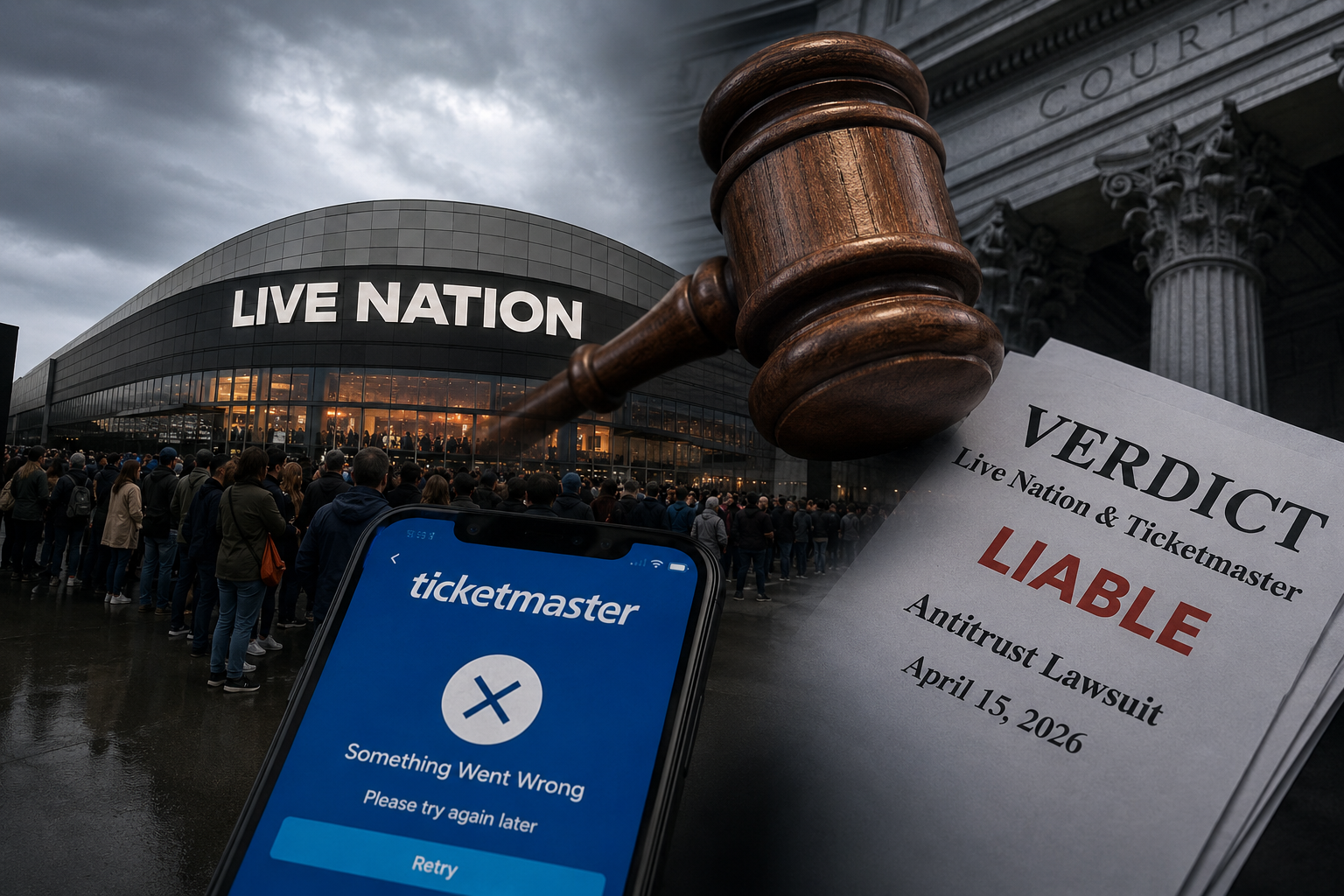
There’s a version of this story that fits neatly into a headline: a jury found Live Nation and Ticketmaster guilty of running an illegal monopoly. Case closed, right? Except it isn’t. Not even close. What happened this April in a Manhattan courtroom was less a conclusion than a starting gun — and the race that followed says more about how corporate power actually gets challenged in America than the verdict itself ever could.
How We Got Here
The resentment toward Ticketmaster didn’t begin with Taylor Swift, though her 2022 Eras Tour presale is where most casual observers picked up the thread. Artists were complaining about the company’s leverage as far back as the 1990s, when Pearl Jam took on Ticketmaster’s fees and market dominance directly. What changed the stakes permanently was 2010, when Ticketmaster merged with Live Nation — folding ticketing, concert promotion, and venue operations into a single corporate structure. That consolidation is the root of everything that followed.
By the time Eras Tour tickets crashed the site and lawmakers hauled Ticketmaster executives before the Senate, the public conversation had already shifted from “the fees are annoying” to a much harder question: can one company control the artist relationships, the venues, the promotion, and the ticket sales all at once — and still leave room for anyone else to compete?
What Actually Happened This Year
On April 15, 2026, a federal jury in the Southern District of New York answered that question. They found Live Nation and Ticketmaster liable on every antitrust count put before them — monopolization of primary ticketing, and illegal bundling of their promotion and venue businesses. Jurors also determined that Ticketmaster overcharged consumers by $1.72 per ticket, a finding tied to sales across 22 states that could eventually translate into a damages award worth hundreds of millions of dollars.
But here’s the twist most casual coverage missed: the federal government wasn’t even part of that verdict. A week into the trial, the Department of Justice cut its own settlement with Live Nation — a deal that let the company keep Ticketmaster in exchange for behavioral changes: divesting exclusive booking rights at thirteen amphitheaters, capping exclusive ticketing contracts at four years, and building an “open distribution” system that lets rival platforms plug into Ticketmaster’s infrastructure. Critics, including members of Congress, called it a slap on the wrist.
Thirty-four states refused to take that deal. They kept litigating, took the case to a jury, and won on every claim. That’s the verdict everyone’s talking about — and it’s a very different outcome from what the DOJ was willing to settle for.
The Fight Isn’t Over — It’s Just Moved Rooms
This is the part that rarely makes it into the headlines: Live Nation is not accepting any of this quietly. The company has already filed post-trial motions arguing the verdict is legally flawed, with arguments heard in district court on July 31. If those motions fail, Live Nation has said it will appeal. Meanwhile, the DOJ’s settlement is now sitting in a mandatory public comment period under the Tunney Act, with a court ruling expected sometime this fall.
At a congressional forum in May, the tone from lawmakers and independent venue operators was blunt: they don’t want another consent decree the company can absorb as a cost of doing business. California Attorney General Rob Bonta made clear the non-settling states are preparing to push for structural remedies — up to and including a full breakup of Live Nation and Ticketmaster — with proposals expected by late summer and a resolution possibly landing this fall. Some witnesses at that hearing went further, calling for price caps on ticket resale entirely, arguing that a breakup alone wouldn’t stop fans from getting gouged on the secondary market.
Antitrust specialists following the case have been careful to temper expectations. Even if the court eventually orders a breakup, any remedy is likely to be stayed pending appeal — meaning nothing changes at checkout next month, or even next year. Analysts at Crowell & Moring don’t expect the matter to be fully resolved before 2028.
Who’s Actually Responsible
It would be tidy to make Ticketmaster the sole villain here, but the full picture resists that simplicity. Ticketmaster has long maintained that the face value of a ticket is set by the artist or promoter, not by the platform — a claim that holds up under scrutiny of how the industry actually prices tickets. Venues and promoters shape the fee structure too. What the jury found wasn’t that Ticketmaster invented high prices out of thin air, but that its structural control over the entire pipeline — from artist booking to venue access to the point of sale — let it entrench that power in ways that shut out competitors.
That distinction matters, because it’s also the throughline connecting this case to a separate, ongoing FTC lawsuit filed in September 2025, which accuses Live Nation and Ticketmaster of advertising deceptively low prices, failing to enforce ticket purchase limits, and letting brokers offload unlawfully acquired tickets on the resale market. Different legal theory, same underlying complaint: the system is built to work against the fan at checkout.
Where This Leaves Everyone Else
For now, the practical reality for concertgoers hasn’t shifted. All-in pricing laws are spreading state by state — New York, Tennessee, Connecticut, California, Colorado, and several others already require it — but that only addresses transparency, not the underlying market structure. Whether Ticketmaster gets broken up, forced into behavioral reforms, or manages to fight the verdict off entirely on appeal will likely take years to settle.
What’s clear is that this case has become bigger than one company’s fee schedule. It’s a live test of whether an increasingly rare form of state-level antitrust enforcement can succeed where federal regulators settled for less — and whether “too big and too integrated to compete against” is still a business model America is willing to tolerate.
At CurrentAffiars, we look beyond the headline to understand the stories shaping people, culture and everyday life. From major legal battles and breaking developments to entertainment, fashion and emerging trends, we bring context to the news rather than simply repeating it. Our coverage follows the people, ideas, businesses and events driving conversations across the United States and around the world. Whether it is a changing entertainment landscape, a new fashion movement, a major business dispute or a story dominating public attention, CurrentAffiars focuses on what happened, why it matters and what comes next.
Sources: Associated Press, Reuters, NPR, TicketNews, Crowell & Moring LLP, Paul Weiss, Kohrman Jackson & Krantz, Time, Live Nation SEC filings (Form 10-Q), New York Attorney General's Office, Federal Trade Commission.