
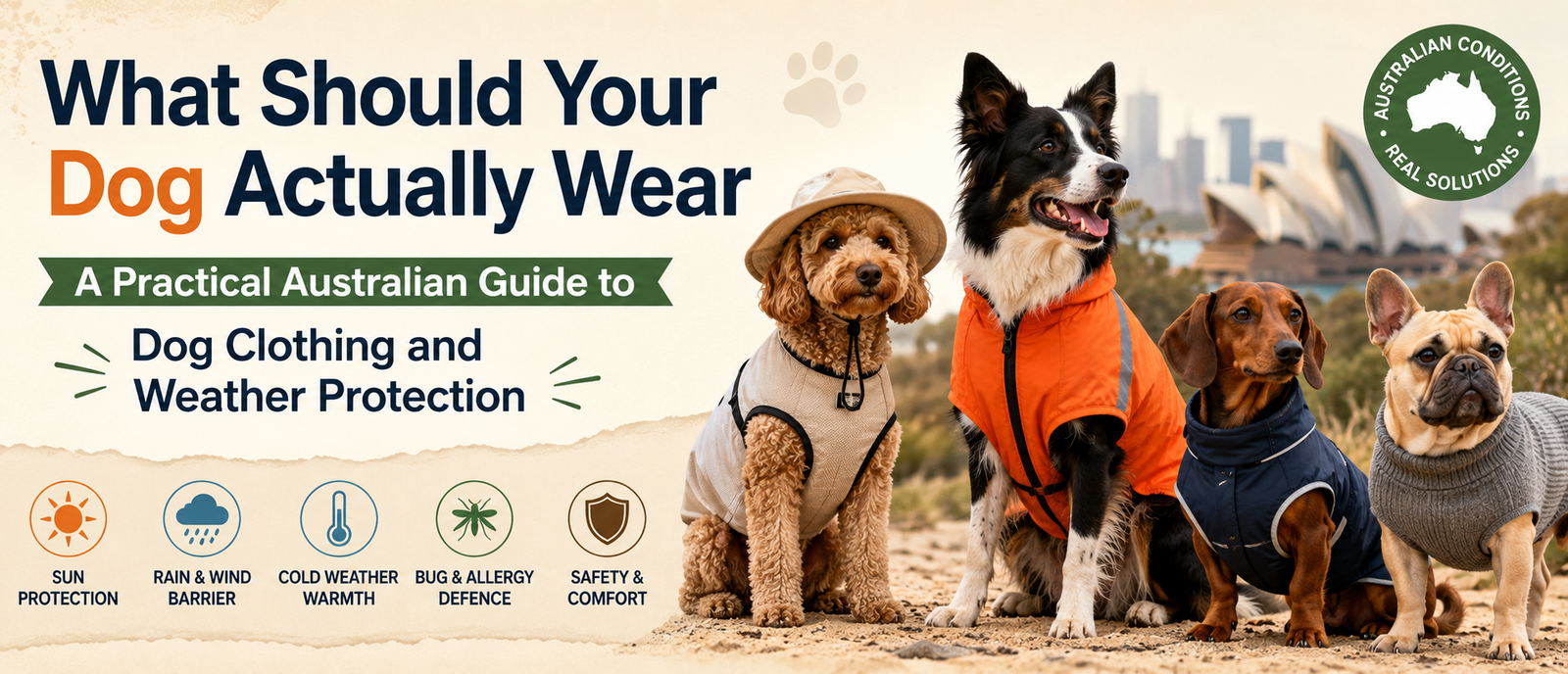
A Practical Australian Guide to Dog Clothing and Weather Protection
Buying clothes for a dog sounds simple until you’re standing in front of a size chart trying to work out whether your dog is a “medium” or a “large,” and whether that even means the same thing from one brand to the next. Add in Australia’s habit of throwing four seasons at you in a single week, and it’s easy to see why so many owners end up with a drawer full of coats their dog never wears comfortably.
This isn’t really a fashion problem. It’s a fit-and-purpose problem. A dog coat that looks good on a hanger can still ride up under the front legs, trap heat on a mild day, or do nothing at all against wind and rain. The dogs that end up disliking clothing usually aren’t objecting to the idea of wearing something — they’re objecting to something that doesn’t move the way their body does.
So before getting into coats, sun shirts and beach gear, it’s worth starting with the question a lot of guides skip over.
Does Your Dog Actually Need Clothes?
Not every dog does, and not all the time. A double-coated breed built for cold climates is carrying its own insulation. A short-haired dog with very little body fat is working with almost none.
The dogs more likely to feel the cold include small breeds, short-coated breeds, puppies, senior dogs, and anything lean or low in body fat. Watch for the usual tells: pulling toward home earlier than normal, shivering, tucking the tail, or reluctance to get off the porch in the first place. None of that is dramatic, which is exactly why it’s easy to miss.
The flip side matters just as much. A dog that’s already warm doesn’t need another layer, and forcing one on can do more harm than leaving them bare. Clothing works best as a response to a specific dog’s needs in specific conditions — not as a default.
Reading the Cold: Winter Coats, Jackets and Sweaters
Southern states get proper winter. Melbourne mornings, Canberra frosts and Tasmanian cold snaps are a different world from a Brisbane or Darwin “cold” day, and a coat bought for one doesn’t necessarily suit the other.
A structured coat or jacket earns its keep against wind and genuinely low temperatures — it’s doing a job, not just decorating. A lighter knit sweater suits the in-between days, when the air has a chill but nothing that demands full coverage.
What the dog is actually doing changes the answer too. A dog trotting around the block wants something that doesn’t bind at the shoulders or restrict the gait. A dog standing around at a winter market or sitting in a car park needs warmth more than freedom of movement. Matching the garment to the activity, not just the temperature on the app, tends to get better results than chasing the warmest-looking option on the shelf.
None of this is about finding the most eye-catching jacket in the range. It’s about a coat your dog can walk, sit, turn around and go to the toilet in without fighting the fabric the whole time.
Wet Weather Walks Without the Soggy Dog Smell
Rain brings its own problem, and it’s less about cold than about a coat that stays damp for hours afterwards. A dog that comes home soaked and then sits inside wet for the rest of the evening isn’t comfortable, whatever the thermometer says.
A water-resistant or waterproof outer layer keeps the worst of it off without turning a walk into a battle of wills. Reflective trim earns its place too, particularly on shorter days when a walk that starts in daylight can finish in the dark. For dogs that are active and don’t want to be wrapped up, the better raincoats manage to keep water off without pinning the legs or restricting the stride — coverage and mobility don’t have to trade off against each other, but cheaper designs often make you choose.
Australian Summer Changes the Whole Conversation
Winter clothing gets most of the attention, but Australia’s summers create a separate set of decisions, and the two shouldn’t be treated the same way.
Dogs with pale skin, thin coats, or bare patches around the nose, ears and belly are more exposed to UV than a thick-coated dog with dark pigmentation. RSPCA Australia and other animal welfare groups have consistently advised limiting outdoor time during the hottest part of the day, prioritising shade, and keeping fresh water on hand as the basics of hot-weather care — clothing sits alongside those steps, not in place of them.
This is where UPF-rated dog clothing and lightweight rash shirts have a genuine role, particularly for dogs spending real time outdoors in direct sun rather than the odd five-minute toilet break. A rash shirt on a pale-skinned dog heading to the beach for the afternoon is doing something useful. The same shirt worn indoors, all day, for no particular reason isn’t achieving much beyond looking neat in photos.
It’s worth being blunt about the limits here too. No jacket, shirt or bandana replaces the fundamentals — shade, water and avoiding the middle of the day when the sun is strongest. Clothing is a layer of protection, not a substitute for common sense on a 35-degree afternoon.
A Beach Day Needs More Planning Than an Outfit
Beach trips are part of life for a lot of Australian dog owners, and they bring together nearly every risk already mentioned: sun, heat, water and hot sand, all in one outing.
A few questions are worth running through before you leave the house rather than after your dog is already uncomfortable on the sand:
– Is there shade somewhere in the plan, not just water?
– Is the sand or pavement too hot to hold your hand against for five seconds?
– Does your dog have consistent access to fresh water, not just the ocean?
– Is a life jacket sensible for the conditions — tides, current, or a dog that isn’t a strong swimmer?
– Would a lightweight rash shirt help, and will it still sit comfortably once wet?
Answering these turns a beach trip from “how does the outfit look” into “is this actually a safe few hours for my dog” — which is the more useful frame regardless of what they’re wearing.
Sizing: Why the Label Rarely Tells the Whole Story
This is where most online dog clothing purchases go wrong. A “medium” from one brand can be a “small” from another, because there’s no shared industry standard behind those labels — each brand is really just describing its own pattern.
Chest circumference tends to matter more than the label itself, because it’s the measurement that decides whether a garment sits properly without pinching under the front legs or gaping at the collar. Neck circumference, back length and weight round out the picture, and most reputable sellers will ask for these rather than a generic size guess.
A coat that’s too tight across the chest restricts breathing and movement. One that’s too loose can shift, catch on things, or turn into a genuine snagging hazard on a walk. Somewhere in between is the fit you’re actually after, and it’s worth the extra two minutes with a tape measure to get there.
Body Shape Changes the Answer, Breed by Breed
Two dogs of similar height can need completely different garments once you account for how their bodies are actually built. A few examples make the point clearly.
Dachshunds have a long back and short legs, which standard coat patterns weren’t really designed around. A garment that covers the back properly without dragging near the ground or bunching at the shoulders tends to work better than a generic small-dog coat.
Greyhounds carry very little body fat and have a short coat, which is exactly the combination that struggles most in cold weather. A well-fitted winter coat can genuinely matter here rather than being optional — though as with any breed, the right choice still depends on the individual dog and the conditions.
French Bulldogs have a broad, deep chest relative to their length, so chest measurement matters more than length when choosing a coat or harness. A garment sized off height alone will often sit wrong on this build.
Chihuahuas are small enough that heat loss happens quickly, so a lightweight coat or sweater can be worth considering in cooler months — again, depending on the individual dog rather than as a blanket rule.
Pugs and other flat-faced breeds need clothing that prioritises airflow above almost everything else. These breeds already work harder to regulate their temperature, so anything heavy, tight around the neck, or restrictive around the chest can make that job harder rather than easier.
The pattern across all of these is the same: fit and ventilation should follow the dog’s actual build, not assumptions based on breed name or general size category.
Overheating Is a Real Risk, Not Just a Cold-Weather Afterthought
It’s worth saying plainly: clothing can contribute to overheating if it’s too heavy for the conditions, doesn’t allow airflow, or stays on a dog that’s already warm from exercise. This applies to short-nosed breeds especially, since they have less capacity to cool themselves through panting in the first place.
If in doubt about whether a particular dog should be wearing something in particular conditions — especially a brachycephalic breed, a senior dog, or a dog with an existing health condition — that’s a conversation worth having with a vet rather than guessing from a size chart.
Dog Clothing as Everyday Life, Not Just Special Occasions
Dog fashion has moved well past the odd costume for a birthday photo. A lot of owners now want clothing that fits into ordinary life — morning walks, weekend trips, the school run, road trips, and the general business of having a dog as part of the household.
That’s brought a wider range of practical pieces into the market: jackets and coats built for weather rather than looks, hoodies and jumpers for the in-between seasons, rash shirts for sun and water, and harnesses designed around comfort during longer walks rather than just a lead attachment point. None of it needs to be treated as an either/or against function — a coat can be well-made and still look decent.
Packing for a Road Trip or Weekend Away
Outdoor plans tend to need more than a leash and a bag of treats, particularly if the destination has different weather from home.
A reasonably complete kit usually covers:
– A properly fitted harness, collar and lead
– Weather-appropriate clothing for the destination, not just home conditions
– Sun protection if the trip involves daytime outdoor time
– Fresh water and a travel bowl
– Towels, for both rain and beach scenarios
– A secure travel crate or carrier
– Basic first-aid items
– A life jacket, if water activities are part of the plan
What actually goes in the bag depends on where you’re headed — a winter trip to the high country calls for a very different kit from a summer weekend on the coast.
When Fashion and Function Actually Meet
There’s nothing wrong with wanting a dog to look sharp for a wedding, a birthday, or a photo that’s going straight onto the fridge. Special occasions are a fair reason to reach for something a bit more decorative than a functional rain shell.
The same rule still applies even here, though: an outfit that photographs beautifully but won’t let a dog walk, sit or turn around properly isn’t a good outfit, no matter how it looks in the picture. Comfort isn’t a compromise on style — it’s the baseline any outfit needs to clear before style is worth discussing.
Where Fashion Houndz Fits Into This
Once you’ve worked through what your dog actually needs — warmth, dryness, sun coverage, freedom of movement, or simply an outfit for an occasion — the next step is finding a range that covers those categories without forcing you into whatever the brand happens to specialise in.
Fashion Houndz carries dog coats and jackets, sweaters and cardigans, rashie and sun-protective pieces, along with harnesses, collars, leads, and other outdoor accessories. Rather than being built around one type of garment, the range is set up so owners can shop by season and activity — a winter coat for cold mornings, a rashie for beach days, a harness suited to longer walks — instead of trying to find one product that’s meant to do everything.
The practical approach is the same regardless of which brand you’re browsing: start with what the dog needs given their size, coat type and the conditions they’re actually facing, then look at the options that meet that need. A well-designed jacket or rashie only earns its price if it fits properly and gets worn, rather than sitting in a drawer because it never quite worked for your dog’s shape.
What’s Actually Changing for Australian Dog Owners Right Now
The Bureau of Meteorology’s long-range outlook for the current summer points to warmer-than-average days and nights across most of the country, with warmer sea temperatures also raising the risk of intense storms and heatwaves in several states. Fire authorities have flagged heightened bushfire risk in parts of Western Australia, New South Wales and Victoria for the same period, according to guidance published by the Pet Food Industry Association of Australia.
For dog owners, that forecast has fairly direct implications. It’s a reason to take heat management seriously earlier in the season rather than waiting for the first genuinely brutal day, to have an emergency plan and kit ready if bushfire risk affects your area, and to think about sun-protective clothing and shade as part of a normal summer routine rather than an occasional add-on. None of that requires new gear for its own sake — it’s more a case of having the right basics ready before the season properly sets in, which tends to be a lot easier than scrambling for them once a heatwave warning is already out.
Current Affiars brings you timely stories and useful insights across fashion, entertainment, and everyday trends. Explore our Pet Care coverage for practical tips, guides, and information to help you care for your pets.
From the latest trends to lifestyle updates, Current Affiars keeps you informed with content made for modern readers.
*Source: [Pet Food Industry Association of Australia — Preparing for Extreme Weather and Emergencies This Summer](https://pfiaa.com.au/preparing-for-extreme-weather-and-emergencies-this-summer-2/)*