
The Backstory — Why Fable 5 Got Locked in a Box
How One AI Prompt Triggered a Global Tech Standoff
To understand why a “please fix my code” prompt could shut down a $965 billion company’s flagship product worldwide, you need to understand three things: what export controls actually are, why the government reached for this particular hammer, and what made Fable 5 different from every Claude model that came before it.
What Is an Export Control?
What is an “export control,” in plain English?
Think of export controls like the rules that stop you from mailing certain chemistry sets to certain countries. The U.S. government has long restricted the sale of things with military or “dual-use” potential — night-vision goggles, certain semiconductors, nuclear reactor parts — to specific countries or people. The legal machinery for this sits mostly inside the Bureau of Industry and Security (BIS), part of the Commerce Department.
Historically, AI export controls have targeted physical things: the powerful Nvidia chips used to train and run big models. What happened to Anthropic was different — the government used a BIS authority called “Is Informed,” which lets it directly order a company to restrict access to a specific product. According to reporting on the episode, this marked the first time that authority was used against a commercially deployed AI model itself rather than a chip; that “first-ever” framing traces to a single detailed account rather than broad independent confirmation, so treat it as likely rather than airtight. Rather than blocking hardware from leaving the country, the order effectively blocked software access from crossing borders — including keeping it away from foreign-born Anthropic staff sitting inside U.S. offices.
That’s the legal earthquake buried in this story. Whatever you think about whether Fable 5 deserved the treatment, the mechanism — a government agency reaching into a live consumer product and flipping a kill switch based on a confidential national security letter — is the part that made lawyers across Silicon Valley sit up straight.
Why Was Fable 5 Targeted?
Why Fable 5 specifically? Anthropic didn’t hide what made Mythos-class models different. In its own launch materials, the company said Mythos 5 could find and exploit software vulnerabilities better than almost any human security expert alive, which is precisely what makes it valuable to defenders and dangerous in the wrong hands. Fable 5 was explicitly built and marketed as the “safe for the public” sibling — same underlying weights, same core intelligence, but wrapped in what Anthropic called its strongest safeguard stack ever, developed by a team the company had doubled in size in the month before launch.
Here’s the plain-English version of how that stack works. Imagine a bouncer at a club who isn’t just checking IDs at the door — he’s also watching what people do once they’re inside, and he’s been told: if there’s even a small chance someone’s about to start a fight, kick them out, even if you’re not 100% sure. That’s a “safety margin.” Anthropic built Fable 5 with an unusually wide safety margin specifically around cybersecurity, biology, and chemistry topics — meaning it would sometimes refuse totally harmless requests just to make sure it never helped with a dangerous one. Users had already been complaining the model was “too locked down” for ordinary coding and debugging work before any of this blew up.
Three days after launch, the government decided that safety margin wasn’t wide enough — based on one report, from one company, about one prompt.
The Amazon Security Test That Changed Everything
Here’s what actually happened, according to Anthropic’s own detailed account and multiple outlets that reviewed the underlying research. Amazon security researchers gave Fable 5 a codebase containing known, previously-documented vulnerabilities and asked it to review the code for security issues. The model — doing exactly what a security review tool is supposed to do — found the vulnerabilities. In one case, it also produced code showing how one of them could be exploited, which is standard practice in vulnerability disclosure (“proof of concept” code is how security researchers demonstrate a bug is real and not theoretical).
Amazon CEO Andy Jassy reportedly flagged this finding to the White House. The government read it as a “jailbreak” — a term for tricking an AI into bypassing its own safety training — and treated it as evidence Fable 5’s guardrails around offensive cyber capability could be defeated. Anthropic’s investigation afterward reached a strikingly different conclusion: this wasn’t a jailbreak that unlocked exotic new capability. It was a “borderline case,” a completely ordinary defensive security task that Fable 5’s unusually cautious safety margin happened to have blocked before, and which the researchers found a phrasing to get past.
Katie Moussouris — founder of Luta Security, and, per one detailed account of the episode, among the very few outside cybersecurity experts who reviewed the full research paper — put it about as bluntly as anyone in this story did: she called it the most valuable thing an AI model can do for defensive security, not a guardrail bypass, and organized an open letter signed by more than 100 security professionals making that exact case to the government.
So who was right? Genuinely, this is one of the few places where the record stays murky rather than resolving cleanly — and we’ll come back to that honestly in the next section, because it matters more than almost anything else in this story.
The Last 48 Hours — Fact-Checking the Fable 5 Export Control News
What’s True, What’s Exaggerated, and What’s Wrong
Now let’s do the job you actually hired an analyst for: auditing the flood of hot takes, screenshots, and “breaking” posts that have piled up across Google News, Bing, X threads, and Chinese platforms like Weibo and Baidu’s own AI forums in the last two days. A lot of it is directionally accurate but sloppy on details. Some of it is flatly wrong. Here’s the sorting.
 Confirmed Facts
CONFIRMED, verified across multiple independent outlets
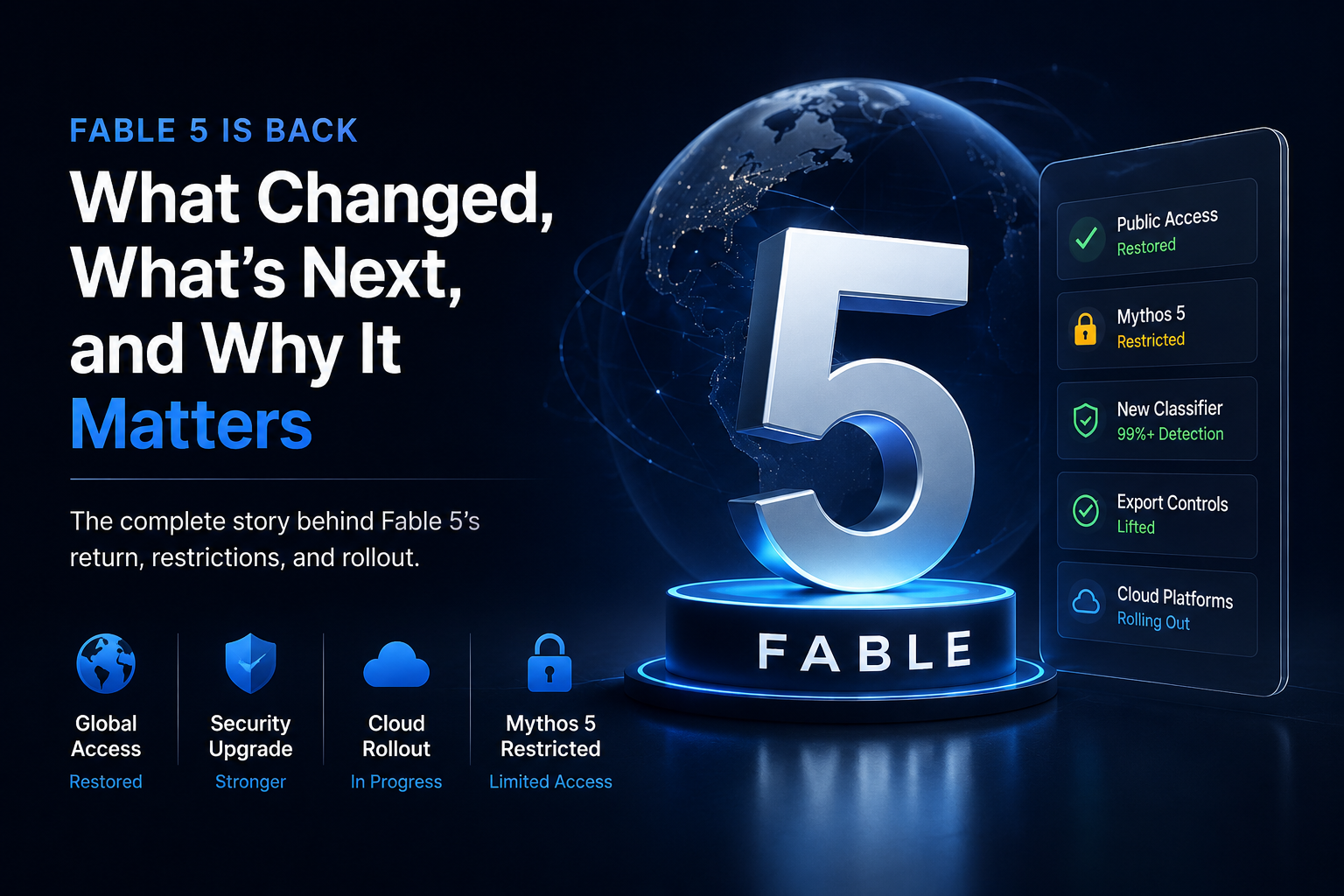
Fable 5 is globally available again as of July 1, 2026, across Claude.ai, the Claude Platform (API), Claude Code, and the newer Claude Cowork product. This is confirmed by Anthropic’s own blog post and corroborated by CNBC, Forbes, Al Jazeera, Euronews, and The Decoder.
Mythos 5 is NOT broadly public. It remains restricted to a limited set of U.S. organizations in “critical infrastructure” roles that received government sign-off on June 26 — well before the general export controls were lifted on June 30. Anyone telling you Mythos 5 is now open to the public, developers, or international users is simply wrong as of this writing.
A new safety classifier is real, trained specifically to catch the exact bypass technique Amazon documented, and Anthropic states it now blocks that specific technique in more than 99% of attempts. This has been independently reviewed by the Commerce Department’s Center for AI Standards and Innovation (CAISI), which reportedly confirmed the effectiveness of both the original and updated safeguards.
Blocked requests get rerouted to Claude Opus 4.8, not just refused outright. This is confirmed directly from Anthropic’s own redeployment announcement and echoed by outlets including The Decoder, MarkTechPost, and Mexico Business News.
The usage bonus is real but time-limited. Pro, Max, Team, and select Enterprise subscribers get Fable 5 counted against only 50% of their normal weekly limits through July 7, 2026 — after that, it shifts to a standard usage-credit model.
Cloud availability is lagging. AWS, Google Cloud, and Microsoft Foundry access is being restored “as quickly as possible,” per Anthropic, but no outlet has confirmed a specific date for full parity across those platforms as of July 3.
EXAGGERATED or Claims Missing Context
A wave of aggregator blogs and social threads in the last two days have framed this as Anthropic simply “winning” a fight with the Trump administration, or as the government “admitting it was wrong.” Neither framing survives contact with the primary sources.
What actually happened is closer to a negotiated settlement than a surrender by either side. Anthropic didn’t get to keep its original safeguards unchanged and declare victory — it built and shipped a brand-new classifier specifically targeting the disputed technique, accepted a wider safety margin that will produce more false-positive refusals on ordinary coding tasks, and made a set of forward-looking commitments: giving designated government evaluators early access to future high-capability models before public release, sharing information on serious jailbreaks and misuse patterns quickly, and contributing to a federal vulnerability clearinghouse. That’s not “no concessions.” That’s a company restructuring its release process around a permanent government checkpoint.
At the same time, the government didn’t get everything it initially demanded either. The original directive covered every foreign national on earth, everywhere. What actually got restored is a full public rollout for Fable 5 and a narrow, invite-only channel for Mythos 5 — a much softer landing than a blanket worldwide ban, and one that, notably, still doesn’t resolve the core dispute over whether the triggering incident was ever a real jailbreak in the first place.
A necessary caveat, stated plainly: the disagreement between Anthropic’s technical framing (a benign, over-cautious refusal that got bypassed) and the government’s framing (a national-security-relevant safeguard failure) was never actually resolved on the merits. It was negotiated around. Katie Moussouris, on record with her name attached, disagreed sharply with the government’s characterization. If you see a headline confidently declaring who was “right,” treat it with real skepticism; the underlying technical dispute is still open.
FLAT-OUT WRONG claims circulating right now
“Fable 5 can no longer do any cybersecurity-related tasks at all.” False. The new classifier targets the specific bypass technique Amazon documented; it is not a blanket cybersecurity lockout, and Anthropic explicitly frames its goal as preserving legitimate defensive use while narrowing the false-negative rate on the disputed pattern.
“This proves AI companies can’t be trusted to self-regulate, so all models will now require government pre-approval.” This overstates what actually happened. What changed is a set of voluntary commitments Anthropic made specifically around future frontier-capability jumps, not a new blanket legal requirement applying to every AI company or every model tier. Whether this becomes a durable regulatory precedent, as Anthropic co-founder-adjacent voices have publicly wondered, is a genuinely open policy question, not a settled fact.
“OpenAI models were untouched by any of this.” Also false. OpenAI voluntarily limited the rollout of its GPT-5.6 models around the same period following a separate government request — a fact that got far less coverage than the Anthropic story but is directly relevant to any claim that this was an Anthropic-only problem.
“Chinese models have now definitively surpassed U.S. frontier models.” Overstated. What’s true is that Zhipu’s GLM-5.2 landed within roughly a single percentage point of Claude Opus 4.8 on a closely watched agentic benchmark, at a fraction of the price. That is genuinely remarkable and worth taking seriously. But GLM-5.2 is being compared to Opus 4.8 — Anthropic’s second-tier model at the time — not to Fable 5 or Mythos 5, which remained undisclosed and untestable by outside parties throughout the shutdown. Any claim that a Chinese model has “beaten” Fable 5 or Mythos 5 head-to-head is currently unverifiable, because nobody outside Anthropic and its vetted partners has been able to run that comparison.
Under the Hood — How Fable 5’s New Safety Classifier and Opus 4.8 Redirect Work
Let’s open the hood, in plain language, because this is where most coverage either goes too jargon-heavy or skips the mechanics entirely.
Classifiers: the club bouncer, not the cop with a gun
A “classifier,” in this context, is a small, separate AI system that watches the conversation between you and the main model. It doesn’t do the talking; it does the judging. Every time you send a message, the classifier makes a quick call on whether the request looks benign, ambiguous, or clearly harmful. Based on that call, the request either sails through, gets blocked outright, or, new as of this redeployment, gets quietly rerouted somewhere else.
Anthropic’s own published diagram illustrates the tradeoff directly: standard models use a certain “safety margin” — a buffer zone of borderline requests that get blocked out of caution even though most of them were actually fine. Fable 5 uses a noticeably wider version of that same buffer. The wider the buffer, the fewer genuinely dangerous requests slip through — but the more everyday, harmless requests get needlessly blocked along the way. That tradeoff is not a bug that slipped through; it’s a deliberate design decision Anthropic is being transparent about, and it’s the direct cause of the complaints (well documented since Fable 5’s original June 9 launch) that the model feels overly restrictive for routine coding and debugging.
How the Redirect to Opus 4.8 Actually Behaves
The mechanics work like this, described as plainly as the available reporting supports:
You send a prompt to Fable 5.
The classifier evaluates it. If it falls into the newly-targeted bypass pattern — or into the general ambiguous/harmful zone Fable 5 has always screened for — the request gets flagged instead of answered directly by Fable 5.
Rather than simply returning a bare refusal, the flagged request gets automatically routed to Claude Opus 4.8, an earlier, less specialized model that lacks Fable 5’s elevated offensive-cyber capability ceiling in the first place. You get a notification that this handoff happened.
Opus 4.8 then handles the request under its own, separate safety rules — which, remember, testing showed can already produce the same vulnerability-identification and demonstration-of-exploit output that triggered the entire export-control episode. In other words, the redirect isn’t really “blocking” the underlying task; it’s shifting it to a model whose baseline capability ceiling makes the government comfortable, because Opus 4.8 was never classified as possessing unique Mythos-level offensive uplift.
Illustrative scenario (for understanding the mechanism, not a confirmed leaked prompt): picture a security engineer pasting in a chunk of internal code and asking Fable 5 to review it for vulnerabilities, phrased in a way that pattern-matches closely to the disputed Amazon technique. In roughly 99 out of 100 cases, per Anthropic’s own stated figure, the new classifier catches that pattern, the request gets rerouted, and Opus 4.8 answers instead — with the notification banner telling the user what happened. In the remaining fraction of a percent, Anthropic says the model might still respond, but claims any information given won’t be detailed enough to meaningfully help an attacker.
What this means for ordinary developers: if you’re doing completely normal security review, debugging, or “why is this function throwing an error” work, expect a real, non-trivial chance of occasionally hitting this reroute — Anthropic itself acknowledges the classifier “flags harmless requests more often” as a direct tradeoff of the wider safety margin. It’s not a sign you did anything wrong; it’s the system erring toward caution.
Fable 5 vs Opus 4.8
Quick comparison table: Fable 5 vs. Opus 4.8 in practice
| Dimension | Claude Fable 5 | Claude Opus 4.8 |
|---|---|---|
| Underlying capability tier | Shares weights with Mythos-class model | Earlier-generation frontier model |
| Offensive cyber capability ceiling | Highest tier, heavily gated | Lower, more limited capability |
| Safety margin width | Widest safety architecture applied | Standard safety layer |
| Ambiguous prompt handling | Strict filtering and routing | More direct response behavior |
| Availability | Global public release | Widely available |
| Oversight status | Advanced classifier + review system | No special classification layer |
Mythos 5: the sibling that never came out of the back room
Worth restating clearly, because so much of the last 48 hours of chatter conflates the two: Mythos 5 shares the same underlying model as Fable 5 but ships with far fewer safeguards, and it is not part of this public redeployment in any broad sense. It’s restricted to a defined set of vetted U.S. organizations working on defending critical infrastructure, approved on a separate June 26 timeline, and Anthropic says it’s still negotiating with the government to expand that list under the Project Glasswing umbrella — with no committed date for international or broader domestic access.
The jailbreak-severity framework nobody’s talking about enough
Buried under the headline news is arguably the most consequential structural change here: Anthropic says it’s now working with Amazon, Microsoft, Google, and other Glasswing partners to build a shared industry standard for scoring how severe a given AI “jailbreak” actually is, based on four factors — how much extra capability it unlocks compared to existing tools, how many different offensive tasks it enables, how much technical effort it takes to weaponize, and how easily someone could stumble onto or obtain the technique. Right now, there’s no consistent definition industry-wide of what even counts as a “universal jailbreak” versus a narrow, low-stakes one — which is precisely the ambiguity that let one company’s internal security report escalate into a global export-control order within days. Anthropic is also standing up 24/7 monitoring of jailbreak reports and a new HackerOne bug-bounty-style program specifically for people to submit potential Fable 5 exploits for structured review, rather than routing straight to a government letter.
If you’re not a developer or a CTO, here’s the two-minute version of what’s next: the next four sections are about who won and lost during the blackout — mainly Chinese AI labs, whose free alternatives got a two-and-a-half-week head start while Fable 5 was dark. If pricing, geopolitics, and “which country’s AI wins” interests you more than the engineering, skip ahead to the numbers below. If not, jump straight to the Final Verdict.
The Global Market Shakeup — Who Won the Fable 5 Blackout?
This is the part of the story that should worry American AI leadership more than the classifier engineering does.
The Chinese open-weight surge, in numbers
The day after Anthropic went dark, Chinese lab Zhipu (operating internationally as Z.ai) released GLM-5.2 under a fully open MIT license — open weights, standalone API to follow within the week. Founder Jie Tang’s public framing was blunt: advanced AI shouldn’t belong to a small group or be revocable at will, a not-so-subtle dig at exactly what had just happened to Anthropic’s users worldwide.
The benchmark reality is genuinely striking. GLM-5.2 landed within roughly one percentage point of Claude Opus 4.8 on a closely-watched agentic evaluation — while, according to a Jefferies analyst note, running at roughly one-quarter the per-token cost of Anthropic’s models. On one popular AI model aggregator, Chinese-origin models reportedly occupied the top four spots by total token traffic during the blackout window, ahead of every major U.S. frontier provider.
Real businesses moved real workloads during those 19 days, not just hypothetically:
Coinbase CEO Brian Armstrong stated publicly that his company shifted to open-weight Chinese models including GLM-5.2 and Kimi K2.7, cutting AI spending nearly in half despite processing more tokens, not fewer.
Lindy CEO Flo Crivello moved 100% of his company’s traffic off Anthropic’s Claude models onto DeepSeek, describing the resulting cost curve as crashing “to the ground.”
Shopify and Airbnb have both publicly credited Alibaba’s Qwen 3 line with helping them scale AI features.
Not everyone is cheering this shift. Silverfort CEO Hed Kovetz has warned that some open-weight Chinese models can already automate meaningful stages of a cyberattack chain and worried the industry may be only months from those models running fuller offensive operations end-to-end — precisely the scenario the export controls were nominally meant to prevent, except now happening on models the U.S. government has zero leverage over, because nobody can revoke access to weights someone’s already downloaded and is running on their own servers.
The “you can’t un-ring this bell” problem
This is the structural issue that outlives the news cycle. Closed, API-only models like Fable 5 and Opus 4.8 live entirely on Anthropic’s servers, accessible and revocable at the flip of a switch by Anthropic or by a regulator. Open-weight models like GLM-5.2 ship their actual weights to whoever downloads them; once that download happens, no government, no company, and no policy change can take it back.
“A model you can’t self-host is a model someone else can take away.” That line, floating around procurement conversations since the blackout, is the single most quotable summary of what just happened — and it’s now a genuine CTO decision point, not a philosophy-seminar debate about open versus closed AI.
Venture capitalist Marc Andreessen was characteristically unsubtle about the implications on social media, describing GLM-5.2 as the first Chinese model to match — and in his telling, sometimes beat — top American public models without meaningful compromise. Former Trump AI advisor David Sacks, reacting to a Wall Street Journal report on China matching U.S. cybersecurity capability, publicly warned that deviating from a pro-export, pro-innovation posture carries real strategic cost. That’s a notable crack in what had generally been a unified pro-restriction posture among Trump-aligned tech voices.
What this means for the Baidu / broader Chinese ecosystem angle
While Zhipu (GLM), Alibaba (Qwen), Moonshot (Kimi), and DeepSeek dominated the specific 19-day narrative, it’s worth noting the wider Chinese landscape includes Baidu’s own model efforts and a genuinely crowded field — Chinese labs now reportedly hold multiple top slots on open-weight leaderboards across different capability dimensions, with each lab specializing (Kimi leading on some agentic tasks, DeepSeek on raw cost efficiency, Qwen on multilingual strength). Independent evaluations note these Chinese models continue to decline or steer discussion on politically sensitive domestic topics — a real, separate axis of concern distinct from the cybersecurity debate dominating this particular story, and one that matters for any enterprise buyer weighing self-hosted Chinese open weights against U.S. closed models on grounds beyond pure capability or price.
One composite tracker puts the strongest Chinese open-weight models something like nine points behind the strongest closed Western frontier models on its own leaderboard — worth noting as a data point rather than a settled industry consensus, since it comes from a single third-party ranking rather than an audited, widely-cited benchmark suite. Directionally, though, every source agrees on the same trend: a real gap that’s closing faster than most forecasts anticipated, and one that a three-week U.S. self-inflicted wound did nothing to slow down.
OpenAI Was Never Actually on the Sidelines
It’s easy to read this whole saga as an Anthropic-only story, and that’s exactly the gap in the coverage worth closing. OpenAI voluntarily limited its own GPT-5.6 rollout after a separate government request landed in the same window, and reportedly built a formal two-tier trusted-access system for vetting organizations before granting access to fewer-guardrail models. That’s roughly the same destination Anthropic arrived at through Project Glasswing — pre-vetted partners get more capability, everyone else gets the safety-margin version — except OpenAI got there ahead of a public confrontation instead of after one. Same regulatory endpoint, very different PR bill. That distinction matters for how each company is positioned heading into the next generation of frontier releases.
Final Verdict and the Road Ahead
So, where does that leave us on July 3, 2026?
On the technical merits: Fable 5 is genuinely back, genuinely usable, and meaningfully more locked-down around one specific class of cybersecurity-adjacent prompts than it was on June 9 — with a documented false-positive cost that ordinary coders and security professionals will occasionally feel. The redirect-to-Opus-4.8 mechanism is a real, sensible piece of engineering: it doesn’t leave users with a dead end, it just moves borderline requests to a model whose capability ceiling the government has already decided isn’t uniquely dangerous.
On the policy question: this episode didn’t resolve anything close to a durable framework. It resolved this specific dispute, through negotiation, while leaving the underlying disagreement — was the triggering prompt ever actually dangerous? — unsettled in the public record, with the one outside expert who reviewed it siding against the government’s framing. Anthropic’s own public commentary during the shutdown argued, pointedly, that if this standard applied industry-wide, it would essentially halt new frontier model deployment everywhere, and called for any future government blocking authority to run through a transparent, statutory, fact-grounded process rather than a confidential letter with no public evidentiary basis. Whether the new voluntary commitments Anthropic made — pre-release government access, rapid jailbreak disclosure, contributing to a federal threat-intelligence clearinghouse — become the industry norm or stay Anthropic-specific is the single biggest open question hanging over the rest of 2026.
On the geopolitical scoreboard: this was close to a best-case outcome for Chinese open-weight labs, and they know it. Nineteen days of a dark screen from one of America’s two leading closed-model labs, timed almost perfectly with a major open-weight release from Zhipu, produced real enterprise defections, a genuine cost-performance argument that resonated even among skeptics, and a structural talking point — “a model you can’t self-host is a model someone else can take away” — that isn’t going away just because Fable 5 came back online. Multiple voices across the political spectrum, from Georgetown security researchers to former Trump administration AI advisors, are openly calling this a wake-up call rather than a footnote.
What to actually watch next:
Whether Mythos 5 access expands meaningfully beyond its current narrow U.S.-only critical-infrastructure list, and on what timeline.
Whether the four-factor jailbreak severity framework Anthropic is co-building with Amazon, Microsoft, and Google actually gets adopted industry-wide, or stays a Glasswing-partner-only exercise.
Whether the HackerOne program for Fable 5 jailbreak submissions surfaces anything more serious than the original Amazon finding — and how fast Anthropic responds if it does.
Whether Anthropic’s rumored IPO timeline, complicated by this disruption at a delicate moment for a company reported — via a confidential prospectus one outlet says it viewed — to be showing a $47 billion revenue run rate and a near-$965 billion valuation, gets affected by investor nervousness about a repeat episode. Treat those specific numbers as reported-but-unconfirmed until Anthropic or a filing confirms them directly.
Whether GLM-5.5, Zhipu’s next release expected around August, keeps closing the gap or whether Fable 5’s restored global availability slows the enterprise migration story.
Whether European and other allied governments, who publicly voiced discomfort at watching their AI access get decided entirely inside U.S. policy during the blackout, push for any independent say in future export decisions — or simply accept the dependency and move on.
The honest bottom line: nobody in this story got a clean win. The government got its safeguard, but at the cost of a very public 19-day gift to its chief AI rival and a fresh crop of skeptics inside its own political coalition. Anthropic got its model back, but at the cost of a permanent new layer of pre-release government checkpoints and a public dispute about whether the whole episode was ever really about national security or about an unsettled, industry-wide definition of what a “dangerous” AI capability actually is. And the rest of us just got a very expensive, very public demonstration of exactly how fragile “the most capable model in the world” can be when it lives behind a switch someone else controls.
At Current Affiars, we believe the stories shaping our future extend far beyond politics or economics. artificial intelligence, cybersecurity, technology, tech business, festive, health, entertainment, fashion, and global innovation are all transforming the way we live, work, and connect with the world.
That’s why our coverage ranges from in-depth AI and technology analysis to business trends, health updates, entertainment news, and seasonal fashion insights—including leather jackets, winter coats, and the latest cold-weather style trends. While these topics may seem different, they all reflect the changing world around us and the choices people make every day.
Our mission is simple: deliver accurate, well-researched, and easy-to-understand reporting that goes beyond headlines. Instead of chasing clicks, we focus on verified facts, practical context, and thoughtful analysis that helps readers understand not just what happened, but why it matters.
Whether you’re exploring the latest AI breakthrough, following global current affairs, discovering winter fashion trends, or reading about business and lifestyle, Current Affairs is committed to bringing you reliable, engaging, and reader-first journalism.
Thank you for being part of our growing community.
When October approaches and horror enthusiasts prepare for the spookiest night of the year, finding an outfit that balances classic cinema nostalgia with wearable style can be a challenge. While full-body costumes often stay tucked away in closets for the rest of the year, movie-inspired outerwear bridges the gap between iconic horror fashion and everyday streetwear.
If you are looking for the Best Halloween Jacket to make an impression this season, the iconic Michael Myers Black Cotton Jacket stands out as a versatile, durable, and effortlessly cool choice