
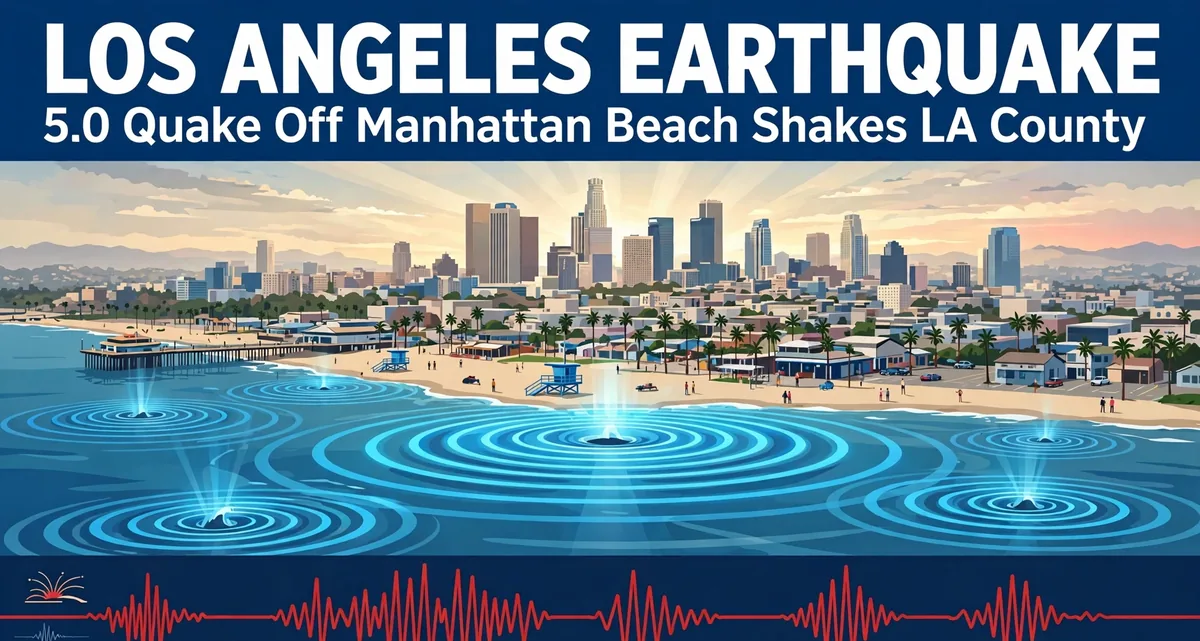
A Los Angeles earthquake measuring magnitude 5.0 struck off the coast of Manhattan Beach at 9:30 a.m. on Saturday, November 28, rattling windows across LA County during the Thanksgiving holiday weekend and sending more than 13,000 people to file “Did You Feel It?” reports with the U.S. Geological Survey within about forty minutes. There are no initial reports of structural damage or injuries, there is no tsunami danger, and the Los Angeles Fire Department has surveyed the city in its full earthquake protocol. Aftershocks have already followed, and officials say more are likely. This is what is known so far; follow our News coverage for updates as they come in.
What Happened, in the USGS Numbers
The quake’s epicentre was about 6 kilometres (3.7 miles) west-southwest of Manhattan Beach, just offshore in Santa Monica Bay, at a depth of roughly 12 kilometres (7.6 miles). The USGS settled on magnitude 5.0 after early readings swung between 4.7 and 5.2 in the first minutes — a normal pattern for a fast-moving event page, and the reason the first alerts many people saw carried different numbers. The agency’s automatic loss estimate (PAGER) is green, its lowest alert level, and its ShakeMap puts the peak shaking intensity at about 5 — strong enough to be felt widely and to rattle homes, below the level that typically causes structural harm.
The shaking was felt across the Los Angeles basin, including Venice, Silver Lake, downtown Los Angeles, Culver City and Inglewood. The USGS ShakeAlert early-warning system detected the quake and pushed alerts to phones — some residents got a few seconds of warning to drop and cover before the shaking reached them. At Los Angeles International Airport, ceiling tiles fell inside a terminal as alarms sounded, and in Santa Monica some shoppers ran out of stores. One Manhattan Beach resident posted photographs of a damaged kitchen — a range hood and broken glasses — while stressing that everyone at home, dogs included, was fine.
The Official Response
The Los Angeles Fire Department went into “earthquake mode,” its standard post-quake protocol: crews from all 106 neighbourhood fire stations survey their districts by land, air and sea, checking critical infrastructure across the city’s 470 square miles. LAFD spokesperson Lyndsey Lantz said there were “no initial reports of structural damage or injuries.” Mayor Karen Bass posted that city teams would continue to monitor and update, and the California Office of Emergency Services said it is working with local officials to assess any impacts. The National Tsunami Warning Center issued its statement at 9:35 a.m.: there is no tsunami danger from this earthquake.
Seismologist Dr. Lucy Jones, of Caltech’s Center for Disaster Resilience, pointed to the quake’s offshore location as the main reason a 5.0 under a dense city caused so little harm: shaking dies away rapidly with distance, and intensity needs to reach around 6 before objects start coming off shelves in earnest. The quake was, she noted, on the deeper side and clearly felt over most of the LA basin. No fault has been officially named yet; the epicentre sits near the Compton thrust fault in the USGS fault database, but investigators have not attributed the quake to it.
Aftershocks: What Has Followed, and What Comes Next
Smaller quakes followed within minutes in the same offshore area: a magnitude 3.0 near Hermosa Beach and a 2.5 near Manhattan Beach about four minutes after the main shock, and a third aftershock of about 3.5 to 3.7 at 10:01 a.m., southwest of Manhattan Beach. That pattern is typical — a magnitude 5.0 main shock commonly produces a tail of smaller aftershocks over the following days, most of them too small to feel, with a smaller chance of one approaching the size of the original. The official advice is unchanged and worth repeating plainly: when shaking starts, Drop, Cover, and Hold On; protect your head and neck under sturdy furniture, away from windows.
The timing gave the quake one unusual witness. Three hours before kickoff in the USC–UCLA rivalry game, the tremor shook the press box at the Rose Bowl in Pasadena, where phones lit up with the ShakeAlert warning — a reminder that on a Saturday built around football, the ground briefly took the headline. For more from our news desk, start at the Current Affiars homepage; and for a sense of how fast official information moves on a breaking story, our explainer on the NSA outage and what officials said caused it is a useful companion read.
Frequently Asked Questions
How strong was the Los Angeles earthquake today?
The USGS reviewed magnitude is 5.0. It struck at 9:30 a.m. PT on Saturday, November 28, 2026, about 3.7 miles west-southwest of Manhattan Beach at a depth of about 7.6 miles. Early readings ranged from 4.7 to 5.2 before the agency settled on 5.0.
Was anyone hurt, and was anything damaged?
As of the first official updates, no. The Los Angeles Fire Department reported no initial structural damage or injuries after putting all 106 stations into earthquake-survey mode. Isolated minor damage was reported by residents — ceiling tiles fell at an LAX terminal and one Manhattan Beach home reported a damaged range hood and broken glass.
Is there a tsunami risk from this earthquake?
No. The National Tsunami Warning Center stated at 9:35 a.m. PT that there is no tsunami danger from this earthquake.
Will there be aftershocks?
Yes, and they have already started — magnitudes 3.0 and 2.5 within minutes, and about 3.5–3.7 at 10:01 a.m. More small aftershocks are likely over the coming days. If you feel shaking, Drop, Cover, and Hold On.
Why did some phones warn people before the shaking?
The USGS ShakeAlert system detects the quake’s first fast-moving waves at seismic stations and pushes alerts to phones before the slower, stronger shaking arrives — often a few seconds of warning, which is what many Los Angeles residents experienced on Saturday morning.